
Best overall for frequent wear: a diamond necklace. Best for a wide colour choice: sapphire. Best for choosing by birth month: the corresponding stone in the guide below. Black Betty is best for shoppers seeking handmade jewellery with personal meaning; this 2026 guide to birthstones helps you choose the stone, setting and wearing habits that belong together.
- Choose birthstones by month first, then compare necklace settings, treatments and care requirements.
- Diamond and sapphire suit frequent-wear necklaces; pearl and opal call for more careful handling.
- Black Betty suits shoppers seeking handmade jewellery with personal meaning.
- A birthstone necklace should express your own story, not promise healing or changes to your energy.
Why this matters
A birthstone gives you a starting point, not a rule about what you must wear. You can choose your birth month, mark a personal turning point, or simply return to a colour that feels like yours.
The practical distinction is between loving a stone and enjoying living with it. A pearl needs different care from a sapphire. An emerald's treatment history matters when you clean it. Choosing well means making room for those differences before a necklace becomes part of your daily routine.
The monthly recommendations below identify gemstones, not confirmed gemstone options for particular designs. When you explore a necklace, check its actual stone, metal, dimensions and care instructions rather than assuming a design name tells the whole story.
What makes the best birthstone necklace?
Use these criteria for your 2026 shortlist before comparing colours:
- Personal meaning: Choose your month, a meaningful association or a colour you genuinely enjoy wearing.
- Stone identity: Confirm the gem species and whether it is natural, laboratory-grown or an imitation.
- Treatment disclosure: Ask about treatments and any resulting cleaning restrictions.
- Setting protection: Check whether vulnerable edges and points are exposed to knocks.
- Fit and balance: Consider chain length, clasp handling and how the pendant sits against your usual neckline.
- Care compatibility: Choose a stone whose care requirements fit your habits, not an imagined version of them.
Hardness measures resistance to scratching, not resistance to every kind of damage. On the Mohs scale, diamond measures 10, sapphire measures 9, and emerald measures 7.5–8. These established mineral properties help explain wear differences, but they do not replace advice about the individual gem and setting.
Birthstones at a glance for 2026
This calendar follows widely used modern birthstone associations documented in the Gemological Institute of America's birthstone guides. Some months have alternatives; those choices are shown together rather than presented as competing products.
| Month | Birthstone options | Best for | Standout quality | Key limitation |
|---|---|---|---|---|
| January | Garnet | Deep colour | Broad colour family | Different garnet species need individual assessment |
| February | Amethyst | Purple expression | Violet to purple tones | Avoid prolonged intense light and heat |
| March | Aquamarine; bloodstone | Pale blue simplicity | Aquamarine's light blue colour | Pale stones need viewing against your skin |
| April | Diamond | Frequent wear | High scratch resistance | Hardness does not prevent chipping |
| May | Emerald | Characterful green | Inclusions give each stone individuality | Treatments affect cleaning choices |
| June | Pearl; moonstone; alexandrite | Soft lustre | Pearl's gentle surface glow | Pearl scratches more easily than harder gems |
| July | Ruby | Rich red | Hard corundum gemstone | Treatments require disclosure |
| August | Peridot; spinel; sardonyx | Fresh green | Peridot's yellow-green character | Avoid knocks and thermal shock |
| September | Sapphire | Colour beyond blue | Broad colour range | Do not assume treatment status from colour |
| October | Opal; tourmaline | Changing light | Opal's play-of-colour | Opal needs protection from heat and knocks |
| November | Citrine; topaz | Warm tones | Citrine's yellow to orange hues | Avoid strong heat and unsuitable cleaning |
| December | Tanzanite; turquoise; zircon | Blue with depth | Tanzanite's blue-violet character | Tanzanite needs protection from impacts |
1. Garnet: best birthstone necklace for January's deep colour
Garnet is a family of gemstones, not a single shade of red. Deep red is the familiar January choice, but other garnet colours offer a different way to wear the same monthly association.
Best for: You want rich colour without choosing a stone solely for sparkle.
Garnet pros:
- Offers more colour variety than its familiar red image suggests.
- Gives a simple pendant a strong focal point.
- Carries January's birthstone association.
Garnet cons:
- Dark stones need assessment in ordinary light.
- Care requirements vary by garnet species.
Verdict: Choose garnet for colour you enjoy in daylight, not just under display lighting.
2. Amethyst: best birthstone necklace for February's purple expression
Amethyst is purple quartz, ranging from lighter violet to deeper purple. A necklace lets that colour sit close to your face, where its relationship with your clothes and complexion becomes more useful than a photograph alone.
Best for: You return to purple as a personal signature.
Amethyst pros:
- Offers a recognisable purple identity.
- Works as a single-stone focal point.
- Connects directly with February.
Amethyst cons:
- Prolonged intense light can affect colour.
- Strong heat is unsuitable.
Verdict: Choose amethyst for its colour, with a storage habit that keeps it out of direct sun.
3. Aquamarine: best birthstone necklace for March's pale blue simplicity
Aquamarine belongs to the beryl family and is associated with March alongside bloodstone. Its pale blue makes sense when you want colour that stays gentle rather than becoming the loudest part of what you wear.
Best for: You prefer a light, understated pendant.
Aquamarine pros:
- Brings a clear blue colour direction.
- Suits visually simple necklace designs.
- Offers a different expression from March's bloodstone alternative.
Aquamarine cons:
- Very pale colour can appear subtle against skin.
- Heat and inclusions require care consideration.
Verdict: Choose aquamarine after checking that its colour remains visible when worn.
4. Diamond: best birthstone necklace for April's frequent wear
Diamond earns the default frequent-wear recommendation through scratch resistance, not through a claim that it is indestructible. A well-considered pendant still needs a secure setting, sensible handling and checks for wear.
Best for: You want April symbolism in a necklace you reach for often.
Diamond pros:
- Has exceptional scratch resistance.
- Offers a clear focal point without requiring strong colour.
- Carries April's birthstone association.
Diamond cons:
- Can chip despite its hardness.
- Appearance alone does not establish origin or treatment.
Verdict: Choose diamond for frequent wear, but keep setting security part of the decision.
5. Emerald: best birthstone necklace for May's characterful green
Emerald's inclusions are part of its individual appearance. They also make treatment disclosure and appropriate cleaning especially important; affection for a perfectly imperfect stone should come with clear information about its care.
Best for: You value distinctive green and visible individuality.
Emerald pros:
- Has a recognisable green identity.
- Offers individual internal characteristics.
- Connects naturally with May.
Emerald cons:
- Many emeralds receive clarity-enhancing treatments.
- Steam and ultrasonic cleaning are generally unsuitable.
Verdict: Choose emerald when you accept careful handling as part of owning the stone.
6. Pearl: best birthstone necklace for June's soft lustre
June offers pearl, moonstone and alexandrite, so your birth month does not restrict you to one appearance. Pearl is the recommendation for a soft surface glow rather than the faceted sparkle of a transparent gemstone.
Best for: You prefer quiet lustre close to your skin.
Pearl pros:
- Offers a distinctive surface glow.
- Creates a gentle visual contrast with metal.
- Gives June a different expression from faceted gems.
Pearl cons:
- Scratches relatively easily.
- Needs protection from perfume and harsh cleaners.
Verdict: Choose pearl for deliberate wear, not an all-activities necklace.
7. Ruby: best birthstone necklace for July's rich red
Ruby is the red variety of corundum, the mineral family that also includes sapphire. It combines a strong colour identity with high scratch resistance, though the particular stone's treatments still matter.
Best for: You want a red pendant with a clear visual presence.
Ruby pros:
- Offers a concentrated red colour direction.
- Resists scratching well.
- Represents July without needing additional symbols.
Ruby cons:
- Treatment type affects care.
- Colour and clarity vary between individual stones.
Verdict: Choose ruby with a clear treatment description, not a colour name alone.
8. Peridot: best birthstone necklace for August's fresh green
Peridot gives August a yellow-green expression, while spinel and sardonyx offer other monthly choices. Choose peridot when that particular green feels right, rather than treating it as interchangeable with emerald.
Best for: You prefer bright, yellow-green colour.
Peridot pros:
- Has a distinctive colour character.
- Offers a clear alternative to deeper greens.
- Carries August's birthstone association.
Peridot cons:
- Needs protection from sharp impacts.
- Sudden temperature changes are unsuitable.
Verdict: Choose peridot for its specific green and give it considerate handling.
9. Sapphire: best birthstone necklace for September's colour freedom
Sapphire is not limited to blue. Its wider colour range makes September especially useful if you want the monthly connection but prefer to choose a colour on your own terms.
Best for: You want personal colour choice alongside scratch resistance.
Sapphire pros:
- Offers colours beyond familiar blue.
- Resists scratching well.
- Suits a colour-led personal collection.
Sapphire cons:
- Treatment cannot be established from appearance alone.
- A hard stone still needs a secure setting.
Verdict: Choose sapphire when colour freedom matters as much as the calendar.
10. Opal: best birthstone necklace for October's changing light
October includes opal and tourmaline. Opal is the choice for play-of-colour: the shifting flashes that make turning a stone in the light part of its appeal.
Best for: You enjoy a stone whose appearance changes with movement.
Opal pros:
- Offers distinctive play-of-colour.
- Rewards viewing from different angles.
- Creates an individual focal point.
Opal cons:
- Is vulnerable to knocks and scratching.
- Solid opals, doublets and triplets require different consideration.
Verdict: Choose opal only after confirming its construction and care instructions.
11. Citrine: best birthstone necklace for November's warm tones
Citrine is yellow to orange quartz and shares November with topaz. Its warm colour is the reason to choose it; symbolic associations remain personal interpretations, not promises about mood, health or prosperity.
Best for: You gravitate towards yellow, amber and orange tones.
Citrine pros:
- Gives a pendant a warm colour direction.
- Offers an alternative to November's topaz.
- Works as a simple single-stone statement.
Citrine cons:
- Strong heat can affect colour.
- Colour does not establish treatment history.
Verdict: Choose citrine because you love wearing warm colour, not for promised effects.
12. Tanzanite: best birthstone necklace for December's blue-violet depth
December offers tanzanite, turquoise and zircon. Tanzanite is the recommendation for blue-violet colour, particularly when you enjoy noticing how a gemstone's appearance changes with viewing direction.
Best for: You want blue with a violet dimension.
Tanzanite pros:
- Has a distinctive blue-violet character.
- Shows different colours along different crystal directions.
- Offers a transparent-gem alternative to turquoise.
Tanzanite cons:
- Needs protection from knocks.
- Steam and ultrasonic cleaning are unsuitable.
Verdict: Choose tanzanite for considered wear in a protective setting.
Choose the necklace, not only the stone
For your 2026 purchase, separate three decisions: the gemstone you want, the setting that protects it, and the chain that makes it comfortable. A beautiful stone does not settle the other two questions.
When considering Black Betty's 6x4 Pear Cut Stone Necklace, confirm the selected gemstone and metal before connecting it to a birth month. A pear-shaped stone's pointed end deserves particular attention when you inspect the setting.
If you are choosing a separate chain, the 9kt Gold Anchor Chain is a catalogue starting point. Confirm pendant compatibility, chain length and clasp dimensions rather than assuming every chain and pendant fit together.
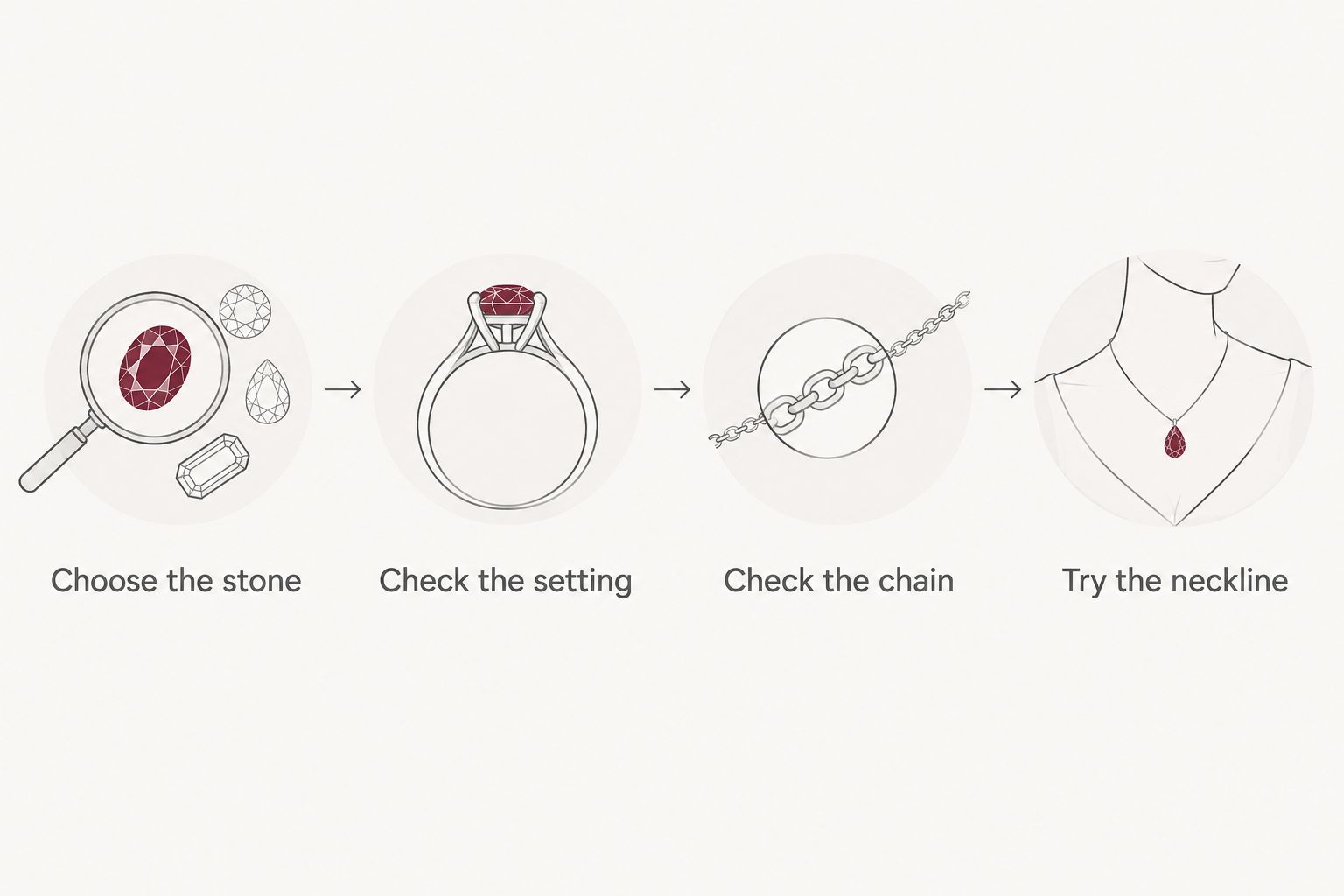
Use this fitting sequence:
- Choose the stone: Identify the gem and its care needs.
- Check the setting: Inspect exposed points and edges.
- Check the chain: Confirm fit and pendant compatibility.
- Try the neckline: See where the necklace rests with clothes you actually wear.
A necklace should also have a place to rest. Store pieces separately, avoid letting harder stones rub against softer ones, and follow the care instructions for the least tolerant material in the piece.
How these birthstones were ranked
This 2026 guide uses calendar order rather than pretending one birth month outranks another. Each recommendation has a distinct role, judged through colour, personal expression, scratch resistance, care requirements and necklace suitability.
The gemstone identities, monthly associations and care distinctions follow established gemmological knowledge, including GIA's birthstone and gem-care guides. The recommendations are a buying framework, not a claim that every gemstone described forms part of Black Betty's necklace selection.
Which birthstone necklace should you choose?
Choose your month's stone first if the calendar connection matters most. Choose diamond or sapphire if frequent wear and scratch resistance lead the decision. For pearl, emerald, opal and tanzanite, make careful handling an intentional part of ownership.
For a Black Betty birthstone necklace enquiry, begin with your preferred month, colour and wearing habits. Those details give you a clearer starting point than asking for the best stone without explaining how you want to live with it.
FAQ
What's the best birthstone necklace for everyday wear?
Diamond and sapphire are strong starting points because they resist scratching well. Neither is indestructible, so setting security, treatments and your activities still matter.
Can I wear a birthstone that isn't my birth month?
Yes, you can choose any birthstone you enjoy wearing. Your own connection to a colour or memory can matter more than its calendar association.
Why do some months have more than one birthstone?
Modern birthstone lists include alternative gemstones for several months. These alternatives give you different colours and material characteristics while keeping the monthly association.
Does Black Betty's Pear Cut Stone Necklace contain my birthstone?
Confirm the selected gemstone on the necklace's current product details or directly with Black Betty. A pear cut describes shape, not gemstone identity or birth-month association.
Are laboratory-grown gemstones real birthstones?
A laboratory-grown gemstone can represent the same monthly gemstone association as its natural counterpart. Confirm the gem species and origin disclosure; an imitation is not the same material.
Can I shower or swim in a birthstone necklace?
Remove your birthstone necklace before showering or swimming unless its maker explicitly advises otherwise. Water exposure, chemicals and the combination of stone, metal and construction affect care requirements.
Do birthstones have healing properties?
Birthstone meanings are symbolic and cultural, not evidence of healing effects. Choose a stone for personal significance and enjoyment rather than promises about health, mood or energy.
One last thing
Before choosing your 2026 birthstone necklace, ask to see the stone away from strong display lighting. Colour is something you will live with, not just admire for a moment. The most meaningful choice is the one that still feels like yours on an ordinary day.