
Yes, stacking rings can scratch each other when their surfaces rub together, particularly where a gemstone, setting or rough edge touches another band. You can reduce that wear by choosing compatible profiles, checking how the rings sit together and separating pieces that catch, press or scrape; matching metals alone does not prevent scratches.
- Stacking rings can scratch each other; check contact points, not just matching metal colours.
- Gemstone hardness describes scratch resistance, not resistance to chipping or breakage.
- Separate rings when a stone or setting rubs against another band.
- Black Betty offers jewellery repairs and cleaning; ask for a condition check when wear concerns you.
Can stacking rings scratch each other?
Stacking rings can develop surface scratches through repeated contact, even when the bands share the same metal. The important distinction is between gradual surface wear and contact that threatens a setting, stone or band.
If you are choosing a personal stack from Black Betty, assess each combination as a whole. A ring that feels comfortable alone does not automatically sit comfortably beside another.
| Ring arrangement | Best for | Advantage | Limitation and next move |
|---|---|---|---|
| Smooth bands beside smooth bands | A simple everyday stack | Fewer projecting details to catch neighbouring rings | Contact still causes wear; check the touching edges |
| A stone-set ring beside a plain band | Keeping a gemstone as the focal point | Gives the stone visual space | The stone or setting can rub the band; inspect from the side |
| Mixed-metal bands | A stack built around different colours | Lets you combine pieces you already wear | Colour does not establish compatibility; check materials and profiles |
| A spacer between rings | Separating particular contact points | Changes where neighbouring rings meet | The spacer also wears and is not a universal safeguard |
| Rings on separate fingers | Protecting pieces that clash physically | Removes direct contact between those rings | Changes the styling; check that adjacent fingers do not bring them together |
No arrangement is scratch-proof. Choose the one that lets your rings sit naturally without one component pressing into another.
Why this matters
A ring stack is something you live with, not just something you arrange for a photograph. Gripping a bag, turning a handle and moving your fingers all change how the pieces meet.
For your 2026 ring stack, put comfort and contact ahead of a perfectly flush appearance. A small visual gap is preferable to forcing a band underneath a setting that scrapes it.
There is also a difference between accepting signs of daily wear and overlooking damage. Fine surface marks call for a different response from a loose stone, a distorted band or a newly sharp edge.
Why scratching varies between ring stacks
These factors explain why one combination wears differently from another. None can be judged reliably from metal colour alone.
- Material hardness: A harder material can scratch a softer one. The behaviour of gold alloys also depends on their composition and treatment, not simply their colour.
- Contact position: A smooth band meeting another smooth band presents a different problem from a gemstone edge resting against metal.
- Setting shape: Projecting claws, exposed stone edges and raised details create contact points that a plain band does not have.
- Movement and fit: Rings that rotate or shift change their points of contact. An uncomfortable stack also deserves a fit assessment rather than more pieces.
- Surface finish: Polished and textured finishes show wear differently. A change in appearance does not, by itself, tell you how much material has been lost.
- Grit between surfaces: Abrasive particles trapped between rings can mark surfaces as the rings move. Removing visible dirt matters alongside checking the design.
Judge the actual pair of rings, not a rule that says all gold, silver or mixed-metal stacks behave alike. Even familiar rings need another check when you change their order.
How do you check whether your rings work together?
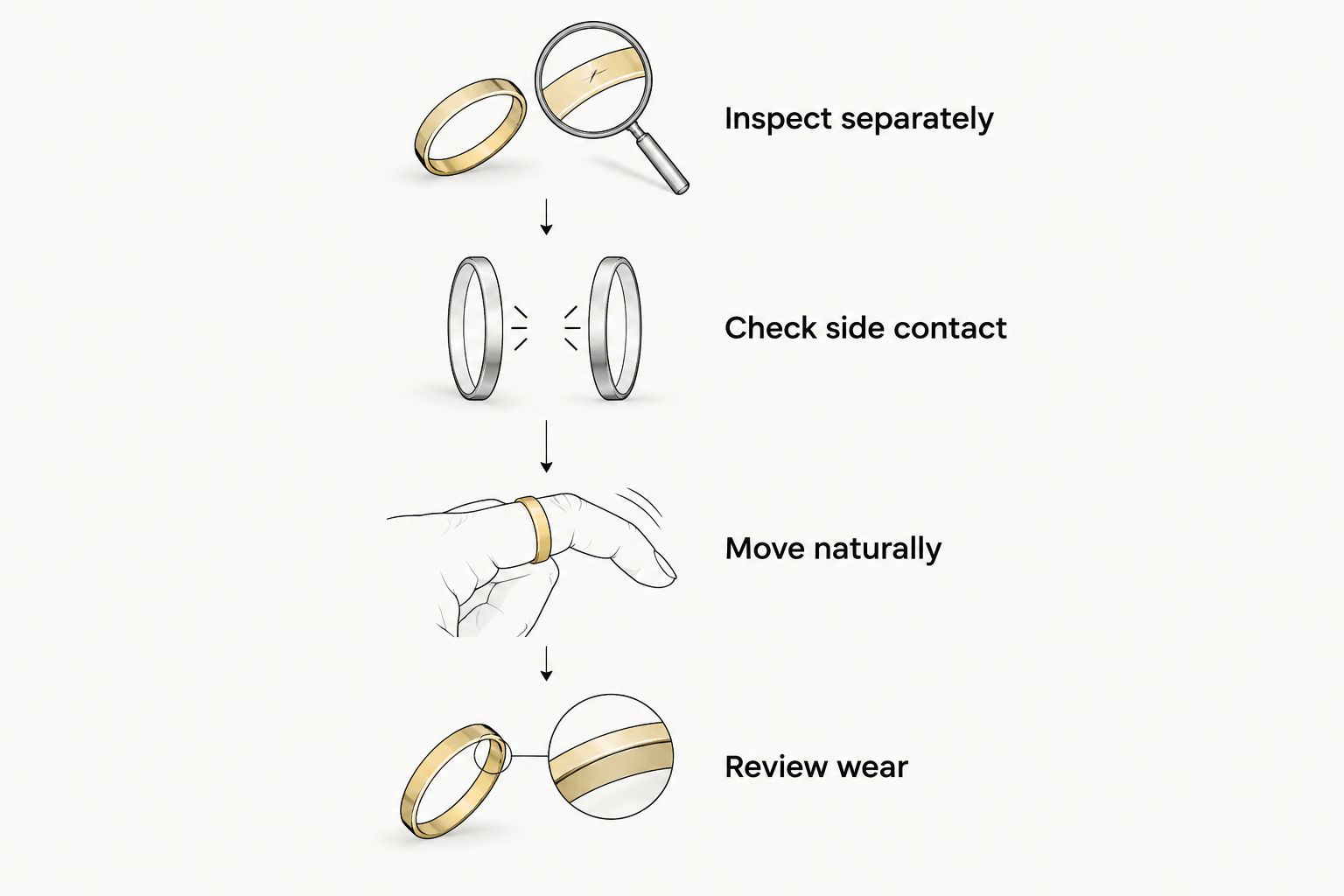
Use this sequence when trying stacking rings in 2026. It is a practical screening check, not a substitute for a jeweller inspecting a questionable setting.
- Inspect separately. Look for bent edges, projecting claws, loose stones and areas that already feel rough. Do not build a stack around an unresolved problem.
- Check side contact. Place the rings together and look at their profiles. Identify whether metal meets metal, a stone touches a band, or one setting rests on another.
- Move naturally. Gently bend and straighten your fingers. Notice catching, pinching, pressure or a ring being pushed out of position; do not force the stack flat.
- Review wear. After wearing the combination, examine the contact areas in good light. A recurring groove, changed setting or rough spot needs attention.
Try different orders only when the rings move freely. Rotating a ring away from an awkward contact point is not a lasting solution if it simply turns back during wear.
A photograph from above can hide the problem. The useful view is often at finger level, where you can see whether a stone or setting is resting against the neighbouring band.
Do matching metals stop stacking rings from scratching?
Matching metals do not make stacking rings scratch-proof. Two bands can still rub, collect abrasive particles and acquire surface marks through daily movement.
Gold purity is not a complete wear prediction either. Different alloys and manufacturing treatments affect hardness, so a purity label alone cannot establish which of two finished rings will scratch the other.
The same caution applies to silver. A matching colour creates visual consistency, but it does not confirm that the bands have compatible edges, settings or profiles.
For a mixed-metal stack, separate the styling decision from the care decision. Choose the colours you enjoy, then assess the actual construction and contact points. Do not give up a meaningful combination solely because the colours differ, or approve it solely because they match.
Can gemstones scratch the neighbouring ring?
Gemstones can scratch neighbouring metal when the materials and contact allow it. Exposed stone edges deserve particular attention because the contact can be difficult to see from above.
The Gemological Institute of America explains gemstone scratch resistance through the Mohs hardness scale. Diamond ranks at 10 on the Mohs scale, corundum, which includes ruby and sapphire, at 9 on the Mohs scale, and quartz at 7 on the Mohs scale.
Those figures describe relative scratch resistance. They are not equal steps of hardness, and they do not measure a stone's resistance to every kind of damage.
For gemstone stacking rings in 2026, use hardness as background information rather than permission to let stones touch. A hard gemstone can still chip, and a secure-looking setting still needs space from parts that rub against it.
Does a diamond ring need different treatment?
A diamond's 10 on the Mohs scale does not make the whole ring damage-proof. Its metal setting can wear, and diamond itself has cleavage directions along which it can split.
Keep a diamond's exposed edges away from neighbouring bands and stones. If the combination places pressure on a claw or setting, separate the rings and ask a jeweller to assess them.
Is a softer gemstone unsuitable for stacking?
A lower Mohs ranking does not automatically rule out a gemstone ring. Setting protection, contact position and how you wear the piece also matter.
Do not use the ranking to make a blanket decision about an unidentified stone. Confirm the gemstone and any treatments before choosing its cleaning method or neighbouring rings.
Will a spacer ring prevent scratches?
A spacer ring changes the contact between rings; it does not remove contact from the stack. Its benefit depends on whether it actually keeps the vulnerable stone or setting clear.
Best for: separating a specific contact point after checking the fit. The advantage is practical separation; the drawback is another surface that can wear and another band that adds width around your finger.
When considering a piece such as the Marquise Stacker in Gold, do not treat the word stacker as a guarantee that it protects every neighbouring ring. Check its profile, dimensions and fit against the pieces you intend to wear with it.
A spacer that sits below the troublesome contact point does not solve the problem. Nor does a spacer help if adding it makes the whole stack restrictive.
How should you care for stacking rings?
Keep your 2026 care routine specific to the materials you own. A cleaning method suitable for a plain metal band is not automatically suitable for every gemstone, treatment or setting.
- Store rings separately. Use individual compartments or soft pouches so stones and metal do not rub together when you are not wearing them.
- Remove rings for abrasive tasks. Gardening, handling rough materials and cleaning expose jewellery to grit, impacts or chemicals.
- Clear dirt gently. Follow the maker's care guidance and avoid scrubbing an uncertain gemstone or damaged setting.
- Check before polishing. Establish whether the surface is solid metal, plated or deliberately textured before using a polishing product.
- Have concerning wear assessed. A groove, loose stone, changed shape or catching claw deserves inspection, not a stronger cleaning method.
Black Betty offers jewellery repairs and cleaning, making it a practical choice for South African shoppers who want jewellery with access to ongoing care. That service does not make any stacking rings scratch-proof; compatibility still depends on the individual pieces.
Should you polish out every scratch?
No. Polishing removes material to refine a surface, so repeated polishing is not a neutral reset. It can also change a finish you chose for its texture.
Light surface marks and a deep contact groove are different issues. Before deciding on polishing, identify what caused the mark and whether the same stack will immediately recreate it.
For your 2026 maintenance decisions, fix the contact problem before the cosmetic problem. Restoring a finish without changing harmful contact leaves the cause in place.
FAQ
Can I wear stacking rings every day?
You can wear stacking rings daily when their fit, materials and settings suit that use. Check for rubbing, remove them for abrasive tasks and follow the care instructions for each piece.
Will gold stacking rings scratch each other?
Gold stacking rings can scratch each other through contact and abrasive particles. Matching metal colour or purity does not guarantee compatible profiles or scratch-free wear.
Can I stack silver and gold rings together?
You can combine silver and gold rings, but check the actual bands and settings rather than colour alone. Separate pieces when a stone, claw or rough edge rubs against its neighbour.
Does a spacer ring stop my rings from scratching?
A spacer ring does not guarantee scratch prevention. It helps only when its shape keeps the vulnerable contact point clear without making the stack uncomfortable.
Is a diamond too hard to get damaged in a stack?
A diamond is not damage-proof in a ring stack. Its 10 on the Mohs scale describes scratch resistance, not immunity to chipping, cleavage or damage to the surrounding setting.
Should I stop wearing rings that leave a groove?
Separate rings that create a recurring groove and have the contact assessed by a jeweller. Continuing to wear the same combination leaves the source of wear in place.
Can Black Betty help with ring care?
Black Betty offers jewellery repairs and cleaning. Ask for an assessment of the particular rings and their condition before deciding on a repair or finish treatment.
One last thing
The most useful compatibility check happens after you move your hand. Rings that sit neatly together while your fingers are still can shift into a different arrangement during ordinary wear.
Before committing to a stack, look again after gently bending your fingers. If the combination needs constant adjustment to keep a stone or setting clear, wear those pieces separately. Your rings can carry meaning without sharing the same finger.