
Clean stacking rings separately, using the care method suitable for each ring’s most delicate gemstone, treatment and setting. For securely set diamonds, sapphires and rubies without treatments requiring special care, lukewarm water, mild washing-up liquid and a very soft brush are suitable; pearls, emeralds, opals and unidentified stones need a more cautious approach. Never put a mixed gemstone stack into an ultrasonic cleaner without a jeweller confirming that every ring is suitable.
- Clean stacking rings separately; the most delicate gemstone or treatment determines each ring’s care.
- Use mild soapy water only when the gemstone, setting and treatment are confirmed suitable.
- Keep pearls, opals and unidentified stones out of ultrasonic cleaners.
- Black Betty stacking rings deserve material-specific care, not one cleaning method for the whole stack.
How do you clean stacking rings with different gemstones?
Separate the rings, identify their materials, inspect the settings, then clean each piece individually. A method suitable for a plain diamond ring is not automatically suitable for an emerald ring worn beside it.
For Black Betty stacking rings, keep each piece’s material details and care instructions together. The same principle applies to rings you already own: gemstone colour alone does not identify the stone or its treatment.
Use this comparison to choose your starting point. Gemological Institute of America gemstone-care guidance distinguishes hardness, toughness and stability; resistance to scratching is only one part of safe cleaning.
| Gemstone or condition | Best for routine care | Benefit | Limitation or caution |
|---|---|---|---|
| Diamond, confirmed suitable for wet cleaning | Mild soapy water and a very soft brush | Removes surface oils and dirt around accessible settings | Fracture filling, damage or loose settings require different care |
| Sapphire or ruby, confirmed suitable for wet cleaning | Mild soapy water and a very soft brush | Cleans without needing a machine | Treatments and fractures still affect suitability |
| Emerald | Gentle cleaning following stone-specific instructions | Avoids the risks of ultrasonic and steam cleaning | Oils and fillers require care; avoid soaking |
| Pearl | Gentle wiping with a soft, slightly damp cloth | Removes surface residue without abrasive scrubbing | Avoid soaking, chemical cleaners and ultrasonic cleaning |
| Opal | Gentle wiping, with advice specific to the opal | Avoids assuming every opal has the same construction | Solid, assembled and hydrophane opals need different precautions |
| Unidentified or visibly damaged stone | Jeweller assessment before cleaning | Prevents choosing a method from appearance alone | Deep cleaning must wait until the materials and condition are known |
These are care categories, not a diagnosis of your jewellery. If the original instructions differ, resolve that difference with the maker before cleaning.
Why this matters
Stacking creates contact. The sides of neighbouring rings touch, while soap, hand cream and everyday residue collect around settings and between bands. Cleaning brings those contact points into view, making it easier to notice wear before you put the stack back together.
Gemstone hardness does not tell the whole story. Diamond measures 10 on the Mohs hardness scale, corundum—the mineral family containing ruby and sapphire—measures 9, and emerald measures 7.5–8. Those figures describe scratch resistance, not whether a stone tolerates heat, chemicals, vibration or a sudden knock.
For your 2026 care routine, organise rings by their actual materials rather than calling the whole collection “gold rings” or “gemstone rings”. A shared metal colour does not mean a shared cleaning method.
Clean your stacking rings in this order
1. Identify every material
Check the gemstone, metal, finish and any treatment information supplied with each ring. Include accent stones: a small stone still matters when deciding whether a cleaning method is suitable.
Do not assume a clear stone is diamond or a green stone is emerald. If you cannot identify a material, leave wet cleaning and chemical products until a jeweller has assessed it.
2. Inspect the ring before adding water
Look for a bent claw, a gap around a stone, a cracked gem or a setting that catches unexpectedly on fabric. Stop if you notice movement, rattling or visible damage; cleaning is not a substitute for repair.
Do not test security by pushing or twisting the gemstone. A loose setting needs attention before brushing, rinsing or further wear.
3. Prepare a separate cleaning space
Work over a soft cloth, away from an open drain. Use a clean bowl for washing and another for rinsing so you can handle each ring without risking it down the plughole.
Keep rings apart throughout the process. Loose pieces knocking together in a bowl defeat the care you are taking, particularly when a harder gemstone can scratch a softer neighbour.
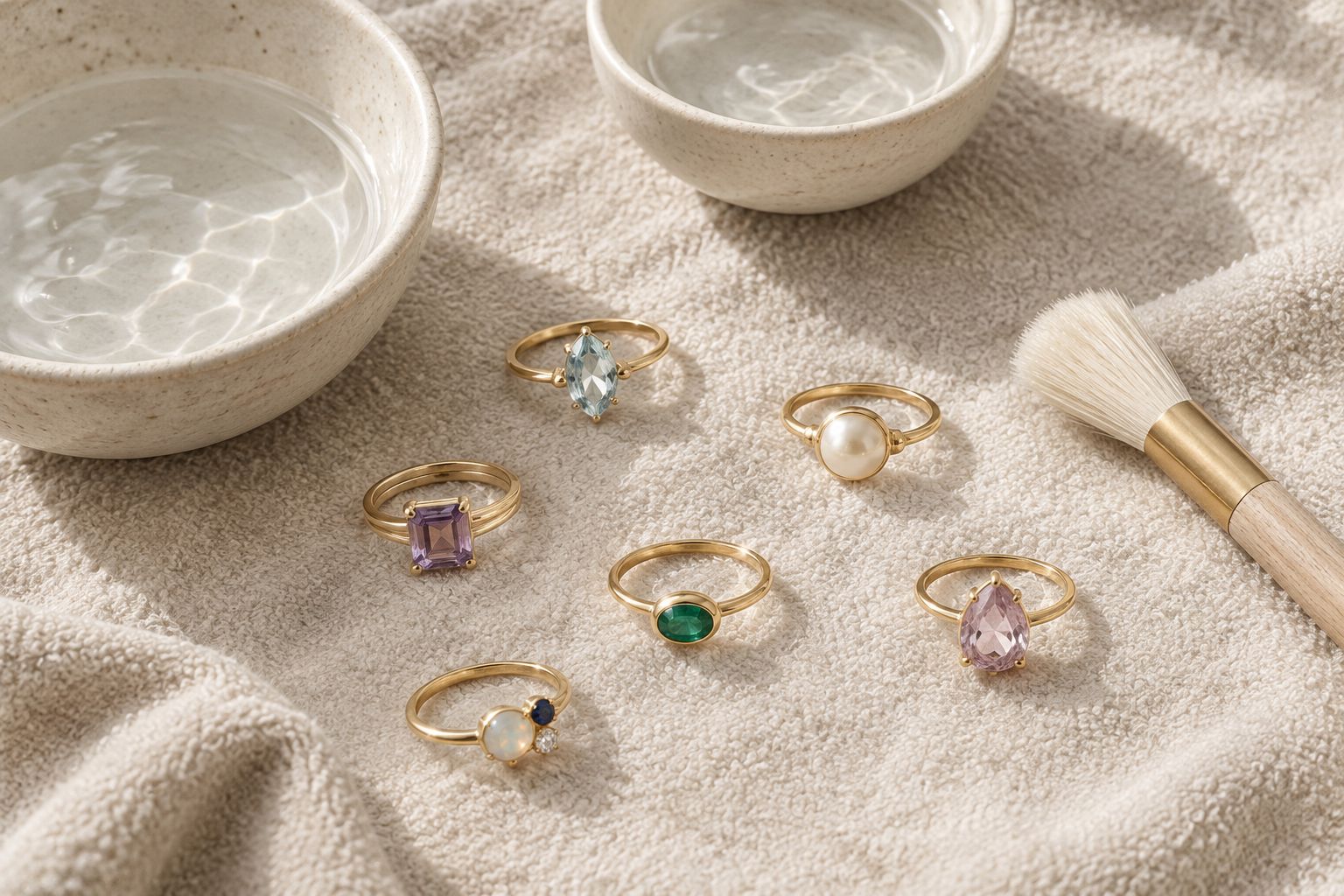
4. Clean only as the materials allow
For a ring confirmed suitable for wet cleaning, use lukewarm water with a little mild washing-up liquid. Gently brush accessible areas with a clean, very soft brush; do not force bristles beneath a tight setting or scrub a stone’s surface to remove something stubborn.
For pearls and other pieces requiring a wipe-only approach, use a soft cloth with minimal moisture. When dirt remains after gentle cleaning, let a jeweller assess it rather than moving to a stronger household product.
5. Rinse suitable rings and dry carefully
Rinse wet-cleaned rings in fresh water to remove soap residue. Keep the rinse temperature similar to the wash water rather than moving a gemstone between hot and cold conditions.
Blot with a soft, lint-free cloth and allow moisture around settings to dry before storage. Avoid hairdryers, radiators and other direct heat sources; speed is not the priority here.
6. Check the stack before wearing it again
Inspect the clean rings in good light. Dirt can hide the edges of settings, so this is a useful moment to notice catching claws, worn contact points or a stone that no longer sits as expected.
Put the rings on individually, then check where neighbouring bands meet. If a setting repeatedly rubs against another ring, ask a jeweller about the arrangement rather than treating the marks as a cleaning problem.
Diamonds, sapphires and rubies: gentle cleaning still comes first
A securely set, untreated diamond, sapphire or ruby generally suits mild soapy water and gentle brushing. That does not make every ring containing these stones suitable for an ultrasonic cleaner.
Diamond can chip despite its high hardness. Sapphire and ruby can also have fractures or treatments that change how they should be cleaned, so the gemstone name is only the beginning of the decision.
Choose gentle hand cleaning over machine cleaning when the treatment history is uncertain. For a 2026 care checklist, record any treatment information alongside the gemstone name rather than relying on memory.
Emeralds, pearls and opals: avoid a shared soaking routine
Emeralds are commonly treated with oils or other fillers. Ultrasonic and steam cleaning are unsuitable, and prolonged soaking is not a sensible default; follow the instructions for the particular stone and treatment.
Pearls need a different touch. Wipe them gently with a soft, slightly damp cloth, avoid abrasive products and keep soaking out of the routine, especially where a pearl is attached with adhesive.
Opal care depends on the material and construction. An assembled opal can contain bonded layers, while hydrophane opal can absorb liquids; do not assume that advice for one opal applies to another.
The benefit of a cautious routine is control. Its limit is that a cloth will not remove every deposit, and persistent dirt belongs with a jeweller rather than under harder scrubbing.
Why cleaning methods vary between stacking rings
The right cleaning method depends on the whole ring, not just its largest stone. Check these factors before choosing a brush, liquid or machine:
- Gemstone stability: heat, chemicals and temperature changes affect gemstones differently, regardless of scratch resistance.
- Treatments: oils, fillers, coatings and other treatments can change which cleaning methods are suitable.
- Construction: glued components and assembled gemstones need different precautions from mechanically secured, single-piece stones.
- Setting condition: loose claws, worn edges and damaged settings turn routine cleaning into a repair question.
- Metal and finish: a cloth or cleaner intended to remove tarnish can be unsuitable for plating, deliberate oxidation or neighbouring gemstones.
- Existing damage: chips and fractures are reasons to stop and seek advice, not to clean more vigorously.
Keep those details when you add a new ring. If you choose a piece such as the Marquise Stacker in Gold, save its supplied material and care information alongside the details of the rings you already wear.
Can you clean gold and silver stacking rings together?
Clean gold and silver stacking rings separately when their gemstones, finishes or treatments differ. The metal combination alone does not determine whether a shared method is suitable.
A silver dip is not a general-purpose gemstone cleaner. Likewise, a polishing cloth designed to remove tarnish is not automatically suitable for a gemstone surface or a deliberately darkened detail.
Mixed metals can stay part of your personal style without sharing a cleaning bowl. For 2026, make the care routine follow each piece rather than the appearance of the finished stack.
Can you use an ultrasonic cleaner for a mixed gemstone stack?
Do not put a mixed gemstone stack into an ultrasonic cleaner unless a jeweller has confirmed every ring is suitable. Vibrations can threaten loose settings, and some gemstones, treatments and constructions are unsuitable for ultrasonic cleaning.
A home machine cannot identify those risks for you. Even if one ring tolerates ultrasonic cleaning, that says nothing about the rings worn beside it.
Ask for an assessment of the complete ring, including its accent stones and condition. “Diamond jewellery” is not enough information to approve a cleaning method.
Build a care routine around the rings you actually wear
Start with observation rather than a fixed cleaning calendar. Look at the underside of settings, the spaces between bands and any places that catch hand cream or soap; clean according to the materials and visible residue.
Remove rings before handling household cleaners and before activities that expose them to hard knocks or abrasive surfaces. Keep individual pieces separated in storage so gemstone edges do not rub against neighbouring jewellery.
Black Betty is best for South African shoppers seeking handmade jewellery with personal meaning. Choosing a piece to live with also means learning its limits: a delicate setting or sensitive gemstone can need more attention than its appearance suggests.
Black Betty offers jewellery cleaning and repairs, which gives you a route for questions that home care cannot resolve. Ask about the specific ring, its gemstone and its condition rather than requesting one cleaning treatment for the entire stack.
Use your next jewellery review in 2026 to check both cleanliness and comfort. A ring that repeatedly catches, twists into another setting or shows fresh contact marks needs a closer look, not simply another polish.
FAQ
What is the safest way to clean stacking rings with different gemstones?
Clean stacking rings separately using a method suitable for each ring’s most delicate gemstone, treatment and setting. Confirm the materials first, and leave unidentified or damaged pieces for a jeweller to assess.
Can I clean my stacking rings with washing-up liquid?
Mild washing-up liquid in lukewarm water suits many securely set diamonds, sapphires and rubies when their treatments allow wet cleaning. It is not a universal method for pearls, opals, emeralds or rings with glued components.
Can I leave gemstone rings soaking overnight?
Do not make overnight soaking part of a mixed gemstone ring routine. Treatments, porous materials and glued components need specific precautions, and prolonged immersion is unnecessary for gentle routine care.
Is a soft toothbrush safe for every gemstone ring?
A soft toothbrush is not suitable for every gemstone ring. Use a clean, very soft brush only where the gemstone, finish and setting allow brushing, and avoid scrubbing pearls or forcing bristles beneath settings.
Can I use toothpaste or bicarbonate of soda to clean rings?
Avoid toothpaste and bicarbonate of soda on gemstone stacking rings. Abrasive cleaning can damage softer materials and finishes; choose material-specific care instead.
Should I take my stacking rings off before cleaning the house?
Remove stacking rings before using household cleaning products. Chemicals, abrasive surfaces and knocks introduce risks that a gemstone’s hardness rating does not address.
When should I take a gemstone ring to a jeweller instead of cleaning it?
Take a gemstone ring to a jeweller if a stone moves, a claw bends, damage is visible or the materials are unidentified. Persistent dirt that does not lift with the approved gentle method also needs professional attention.
One last thing
A clean stack can reveal a fit problem that dirt was hiding. Before putting every ring back in its usual position, look at the sides of the bands and the edges of neighbouring settings.
If the same two rings repeatedly rub, changing their order is not a substitute for checking whether they sit safely together. Ask a jeweller to assess the contact points, particularly where a gemstone or raised setting touches another band.
Your rings can carry different meanings and still need different care. Keep the styling personal; keep the cleaning specific.