
To stop stacking rings from spinning, check each ring’s fit on its own, then rebuild the stack with comfortable, well-fitting bands and settings that sit together without pushing. A jeweller can assess persistent turning, especially when a ring must pass over a larger knuckle; adding more rings or sizing down without checking the whole stack is not a reliable fix.
- Stop stacking rings from spinning by checking individual fit before changing the whole ring stack.
- A snug neighbouring band can limit movement, but it cannot correct every loose or top-heavy ring.
- Black Betty stacking rings suit personal styling; choose by fit and compatibility, not appearance alone.
- Ask a jeweller about persistent turning, especially when your knuckle is wider than your finger’s base.
How do you stop stacking rings from spinning?
Find out whether the ring is loose, unbalanced or being pushed by its neighbours before choosing a fix. A ring that turns when worn alone needs a different assessment from one that only rotates inside a stack.
If you are building your first combination in 2026, the guide to stacking rings for your first ring stack offers a useful starting point. Settle the fit before adding another piece.
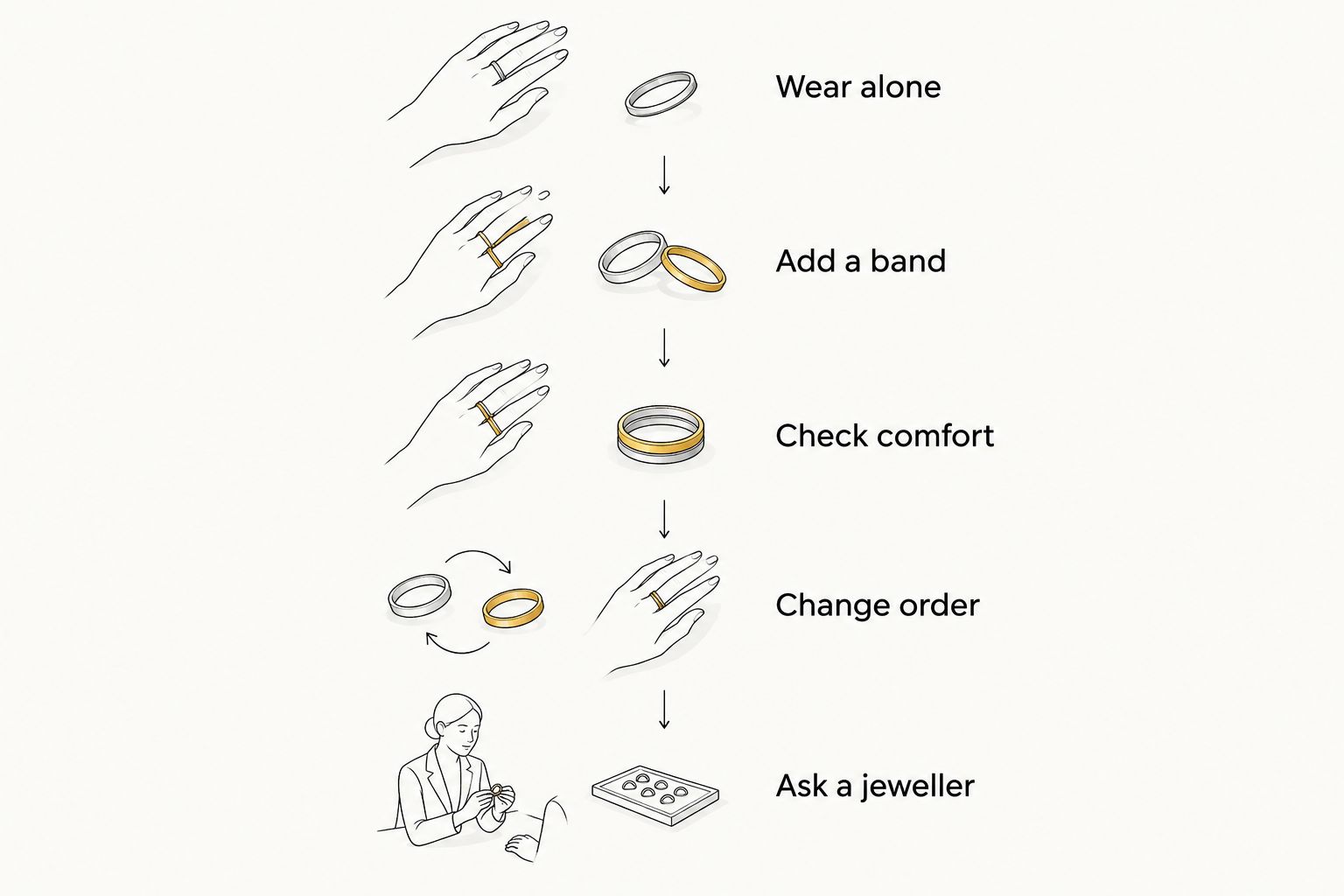
Use this sequence with the rings you already own:
- Wear 1 ring alone. Notice whether it rotates during ordinary hand movements or feels loose at the base of your finger.
- Try 2 rings together. Add a neighbouring band and check whether the original ring stays more settled or begins to tilt.
- Test 3 rings only if comfortable. Bend and straighten your finger. Remove a band if the combination pinches or restricts movement.
- Change the order. Check whether a raised setting is catching on another ring instead of sitting freely beside it.
- Take persistent movement to a jeweller. Bring the full stack, not just the ring that turns.
The goal is comfortable stability, not a ring that cannot move at all. Some rotation is normal; repeated turning that leaves a setting underneath your finger deserves attention.
Why this matters
A ring stack can look balanced while feeling wrong on your hand. A neighbouring band can steady a ring, but it can also push against a setting, make the combination feel tighter or conceal a poor individual fit.
Do not trade comfort for a setting that stays upright. If keeping a ring in place requires squeezing your finger, the arrangement needs changing. Your hand should still move naturally when you type, hold a mug or make a loose fist.
For a stack you plan to wear throughout 2026, assess the ordinary moments rather than the photograph. Jewellery needs to work on your hand, not just look right when your fingers are still.
Which fix suits your spinning ring?
Start with the least permanent change that addresses the actual problem. Reordering rings is easy to reverse; altering a ring requires a professional assessment of its construction and fit.
| Approach | Best for | Advantage | Limitation |
|---|---|---|---|
| Change the ring order | Movement that begins when rings touch | Tests whether neighbouring settings are pushing against each other | Does not correct an oversized ring |
| Add an existing, well-fitting band | A loose arrangement that needs checking as a complete stack | Shows whether a neighbouring band reduces movement | Adds width and can make the stack feel too tight |
| Reduce the stack | Pinching, crowding or restricted finger movement | Removes pressure from the combination | Changes the look and does not fix a loose individual ring |
| Ask about a temporary ring adjuster | Checking a reversible fit adjustment | Avoids immediately committing to a permanent alteration | Needs suitable placement, comfort checks and cleaning |
| Ask about sizing beads | A ring that turns despite needing room over the knuckle | Offers a professional alternative to simply reducing the whole circumference | Not suitable for every ring or finger |
| Have resizing assessed | A consistently loose ring | Addresses the ring’s fit rather than disguising it | Construction and stone placement can limit alteration |
None of these options is a universal answer. Choose the one that matches what happens when you wear the ring alone and beside its neighbours.
Changing the order: best for rings that push against each other
Move the turning ring to another position in the stack, then check whether the settings still touch. Watch for a raised detail resting on a neighbouring band instead of allowing both rings to sit naturally.
This is a useful first test because you are changing the arrangement, not the jewellery. It is not proof that every ring in the combination fits correctly.
Professional fit adjustments: best for persistent turning
Ask a jeweller to assess both the knuckle and the finger’s base. A ring can need enough room to pass over the knuckle yet feel loose once it reaches its wearing position.
Sizing beads are small additions inside a ring’s shank that a jeweller can assess as an alternative to straightforward downsizing. They are not appropriate for every design, so ask how an adjustment would affect comfort, cleaning and future alteration.
Why stacking rings spin
Several different causes can produce the same irritating result. Look at the whole arrangement before deciding that every ring needs to be smaller.
- Individual fit. A ring with excess room at the finger’s base has space to rotate. Test it alone to separate its fit from the stack’s behaviour.
- Knuckle shape. A wider knuckle can require an opening that feels looser farther down the finger. Simply choosing a smaller size can make removal difficult.
- Weight distribution. A prominent setting places more weight on one side of the ring. That weight can encourage the setting to turn when the band has room to move.
- Combined width. Several bands occupy more finger space than a single band. Assess the full stack rather than assuming each ring will feel the same together as it does alone.
- Contact between settings. Neighbouring rings can push or tilt one another. More jewellery does not automatically mean more stability.
- Changes in finger size. Temperature and swelling affect fit. A ring that feels secure at one point in the day can feel different later.
When reviewing your everyday stack in 2026, note the circumstances as well as the movement. Whether a ring turns alone, after adding a band or only when your hands are cold gives a jeweller useful information.
How to check fit without making the stack too tight
A well-fitting stack needs to pass over your knuckle, sit comfortably and come off without force. Look for light resistance at the knuckle rather than choosing the tightest fit you can tolerate.
Start with clean, dry hands and check the rings in normal conditions. Do not make a permanent sizing decision immediately after your hands have become unusually hot, cold or swollen.
Then test the movements you actually use:
- Make a loose fist and open your hand again.
- Bend the finger without forcing it.
- Hold an everyday object and notice pressure between the bands.
- Remove the rings and check whether any one band is difficult to take off.
Comfort is the deciding test, not whether the stone remains perfectly centred. Pain, tingling or a change in finger colour is a reason to stop wearing the arrangement. Seek urgent medical help if a stuck ring is associated with those symptoms.
Avoid repeatedly adding bands to trap a loose ring in place. You can end up with a crowded stack while leaving the original fit problem unresolved.
Choosing a ring to join your stack
Choose a new ring for the space it will occupy, not just for how it looks on its own. Consider its width, setting and contact with the pieces you already wear.
Black Betty is best for South African shoppers seeking meaningful jewellery for personal everyday styling. For stacking rings, the practical question remains whether the chosen piece fits comfortably beside your existing bands.
The Marquise Stacker in Gold is a relevant design to consider when exploring a personal arrangement. Its name is not a promise that it will stop another ring spinning: check the current product details and assess the combination on your hand.
A new piece gives you another way to shape the stack, but it also adds another surface and setting to accommodate. Do not buy a ring solely to compensate for an unresolved fit problem.
If you are adding to Black Betty stacking rings in 2026, bring or wear the existing pieces when seeking fit advice. The full arrangement is more useful than a photograph of the finished look.
Can a tighter band stop another ring from spinning?
A well-fitting neighbouring band can reduce movement, but a deliberately tight band is not the answer. It can help stabilise an arrangement without correcting the fit or weight distribution of the turning ring.
Test the combination with a band you already own before buying another. If the stack pinches, becomes difficult to remove or restricts bending, take the extra band out.
Should you size down all your stacking rings?
No: assess each ring separately and then check the full stack. Uniformly sizing down can leave you with rings that are difficult to pass over your knuckle or uncomfortable together.
Ask a jeweller to distinguish a genuinely oversized ring from a ring that needs room over a prominent knuckle. The same visible symptom does not require the same alteration.
FAQ
Is it normal for stacking rings to move around?
Some movement is normal for stacking rings. Repeated rotation that leaves a setting underneath your finger, or movement accompanied by discomfort, calls for a closer fit check.
Why does my gemstone ring keep turning upside down?
A gemstone ring can turn upside down when its setting is heavier than the underside and the band has room to rotate. Check it alone first, then ask a jeweller to assess the fit if the turning persists.
Will adding another stacking ring stop the spinning?
Adding a well-fitting band can reduce movement, but it does not reliably fix an oversized ring. Check that the additional width does not cause pinching or make removal difficult.
Can I use a temporary ring adjuster on stacking rings?
A temporary ring adjuster is a reversible option to discuss with a jeweller. Check its suitability for the ring, keep it clean and remove it if it irritates your skin or crowds neighbouring bands.
Can every spinning ring be resized?
Not every spinning ring is suitable for resizing. A jeweller needs to inspect its construction, material and stone placement before recommending an alteration.
How do I check the fit of Black Betty stacking rings?
Check Black Betty stacking rings individually, then wear the intended combination and test comfort, movement and removal. Take the full stack to a jeweller if a ring keeps turning or the fit feels wrong.
Should stacking rings fit tighter in summer?
Do not deliberately choose an uncomfortable fit for summer. Heat-related swelling changes how rings feel, so assess comfort under normal conditions and remove rings before swelling makes removal difficult.
One last thing
A ring that needs room over your knuckle is not necessarily the wrong size everywhere else. That distinction is why repeatedly choosing a smaller ring can fail to solve spinning.
Before changing your stack in 2026, take the turning ring off and wear it alone again. Solve the fit first; build the expression around it. You do not need every setting to remain perfectly still for the jewellery to feel like yours.