
You should take off your birthstone necklace before sleeping, even if you wear it every day. Bedding can catch a chain or setting, and sleeping against a pendant puts pressure on the jewellery; removing it before bed avoids that unnecessary wear.
- Take your birthstone necklace off before bed; everyday wear does not mean overnight wear.
- Blackbettydesign jewellery suits South African shoppers choosing personal, meaningful adornment for everyday wear.
- Check the chain, clasp and gemstone setting before putting your necklace back on.
- Store gemstone jewellery separately and choose cleaning methods for the specific stone and metal.
Can you sleep in a birthstone necklace?
The better routine is to remove your birthstone necklace before you sleep. A small pendant or a smooth chain can feel comfortable enough to forget, but comfort does not tell you whether the chain is twisted or the setting is caught in fabric.
For jewellery from Blackbettydesign, as with other gemstone jewellery, follow the care instructions for the particular piece. A birthstone describes a personal connection to a gemstone, not a standard of durability.
Make this your evening routine:
- Unfasten the clasp. Support the pendant rather than pulling the necklace over your head.
- Check for catches. Look for trapped hair, a twisted chain or a setting that has started snagging.
- Put it away separately. Lay the chain without tight bends, keeping the pendant away from other jewellery.
- Check before wearing again. Leave the necklace off if the clasp does not close securely or the stone appears loose.
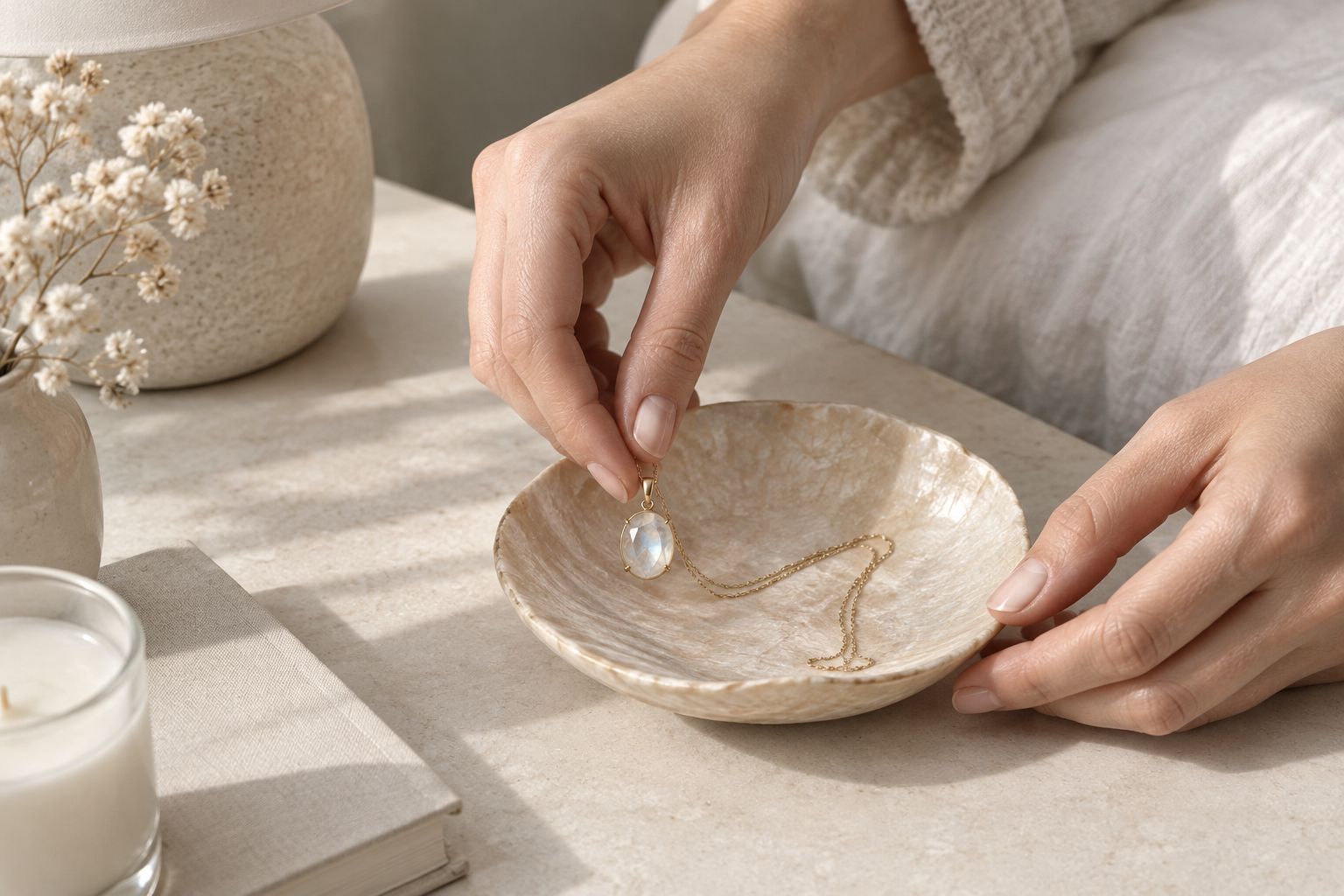
Keep a jewellery dish or lined compartment somewhere you can reach before getting into bed. The easiest routine is the one that does not require you to get up again.
Why this matters
A necklace can become part of how you recognise yourself. You put it on without much thought, touch the pendant during the day and miss it when it is not there. Removing it at night does not interrupt that meaning; it gives the piece a deliberate place in your routine.
For your 2026 jewellery-care routine, separate two ideas: a piece you wear daily and a piece you never remove. They are not the same. Choosing a necklace for everyday use still means considering how you sleep, shower, exercise and store it.
You do not need a complicated care ritual. Start with removing the necklace before bed, checking it when you put it on and using cleaning instructions that match its materials.
Why overnight wear affects necklaces differently
The gemstone is only part of the necklace. A strong stone cannot protect a fine chain from being pulled, and a substantial chain cannot stop a projecting setting from catching.
These details change how a necklace behaves against clothing and bedding:
- Chain construction: Fine links and heavier links do not respond to pressure in the same way. Neither should be treated as immune to pulling or twisting.
- Setting shape: Projecting claws and detailed edges create places where threads can catch. A smooth setting reduces those catching points, but does not make overnight wear advisable.
- Gemstone characteristics: Hardness, toughness and treatments affect care. The name of your birth month does not establish any of them.
- Pendant size and position: A pendant that rests comfortably while you stand can press against you when you lie down.
- Layering: Several chains create more opportunities for crossing and tangling than a single necklace.
- Existing wear: A clasp that does not close properly or a setting that already snags needs attention before further wear.
Remove the whole necklace, not just the pendant. Leaving the chain on keeps the twisting and catching risks in place.
Does gold or silver make a difference?
Gold and silver need material-specific care, but neither makes sleeping in a birthstone necklace a good habit. Metal composition is useful information when you choose a piece; it is not permission to ignore the chain and setting.
For reference, 9kt gold contains 37.5% gold, with other metals making up the alloy. Sterling silver contains 92.5% silver. Those figures describe composition, not a guarantee against scratches, bending or damage.
When choosing jewellery in 2026, distinguish solid gold, sterling silver and gold-plated finishes rather than treating everything gold-coloured as the same material. Check the exact product description, including the chain, because a photograph cannot establish composition.
For a plated necklace, follow the care instructions for that finish as well as the gemstone. Do not assume advice for a solid-gold piece applies unchanged to plating, or that a product intended for silver is suitable for every stone attached to it.
Which birthstone necklace details should you compare?
Choose your necklace for the way you want to wear it while awake. A fine chain and a small gemstone offer a different visual effect from a more pronounced pendant, but neither needs to stay on overnight to become your everyday piece.
The Blackbettydesign birthstone necklace selection includes these two designs. The comparison below uses their stated product details, not assumptions about unspecified chain lengths, clasps or gemstone treatments.
| Necklace | Best for | Stated details | Strength | Limit to consider |
|---|---|---|---|---|
| The Birthstone Necklace | A simple gemstone on a fine chain | Natural, faceted gemstone set on a fine chain | A restrained design that keeps the stone central | The description does not establish overnight suitability; remove before bed |
| The Pear Birthstone Necklace | A defined pear-shaped gemstone | Natural 6x4mm pear-cut gemstone | A clearly specified stone size and recognisable shape | Stone dimensions do not tell you the chain length or how the pendant sits on you |
Choose the shape you want to live with, then confirm the practical details. Ask about the exact metal, chain length, fastening and care requirements for your selected gemstone. Do not infer these from another colour or a similar-looking piece.


Does a harder gemstone mean you can leave it on?
Gemstone hardness is resistance to scratching, not resistance to every kind of damage. Toughness concerns resistance to breaking and chipping. A stone can perform differently on those measures, and neither measure describes the strength of the necklace clasp.
That distinction matters when you read jewellery advice in 2026. A claim about a gemstone being hard does not establish that its setting tolerates pressure from sleeping, or that the chain will not catch.
Choose care instructions by the actual gemstone, its treatments and its setting. Avoid using a general birthstone chart as a cleaning guide: stones associated with the same month can require different care.
Personal symbolism is a separate choice. You can wear a gemstone because it marks your birth month, recalls someone important or simply feels like your colour. None of those meanings requires keeping the necklace on while you sleep.
How should you store a birthstone necklace overnight?
Keep your necklace separate, dry and free from tight tangles. A lined jewellery compartment or a suitable pouch gives it a defined place without placing other pieces directly against the pendant.
Lay the chain gently rather than winding it tightly around the stone. Keep it away from the edge of a bedside table, where a hand, book or charging cable can pull it down.
If you also wear stacking rings, do not drop them onto the necklace in a shared pile. Separate storage helps prevent contact between hard edges, gemstones and fine chains. It also makes it easier to see whether the necklace is tangled before you lift it.
Keep jewellery away from bathroom splashes and open cleaning products. A convenient location is useful only if it also protects the piece from avoidable contact.
What should you do if you accidentally sleep in it?
Waking up with your necklace on does not prove that it is damaged. Take it off carefully and inspect it before wearing it again. Do not pull against a snag or force a knot because you are in a hurry.
Look along the chain for tight twists, stretched-looking links or an obvious kink. Check that the clasp closes properly and that the pendant sits as it normally does.
If the setting catches where it previously felt smooth, or the gemstone appears to move, stop wearing the necklace and have a jeweller inspect it. Do not press claws back into place yourself.
For 2026 and beyond, make this a check rather than a worry ritual. An accidental night calls for attention, not an assumption that the piece is ruined. Return it to its usual storage place the following evening.
Should you clean your necklace every night?
You do not need to use a cleaning solution simply because you have taken your necklace off. Start with a visual check, then follow the cleaning guidance for its particular metal and gemstone.
Do not choose ultrasonic, steam or chemical cleaning without confirming suitability. Gemstone treatments and construction matter, so a method used for one necklace is not automatically right for another.
If you use a cloth, make sure it is appropriate for the piece; a chemically treated polishing cloth is not the same as a plain soft cloth. Avoid vigorous rubbing around claws, delicate links or plated surfaces.
Ask for specific instructions when you buy. Knowing what not to use is often more useful than collecting several jewellery-cleaning products with overlapping claims.
Can you sleep in a birthstone necklace if the pendant is small?
A small birthstone necklace should still come off before bed. A lighter pendant reduces bulk, but the chain, clasp and setting remain exposed to catching and pressure.
Choose a small pendant because you like its proportion or how it layers, not because it promises uninterrupted wear. Small jewellery still needs care.
Is sleeping in a necklace different from wearing it all day?
Sleeping in a necklace adds contact with bedding and pressure from positions you do not consciously control. Daytime comfort therefore does not establish overnight suitability.
Keep everyday wear practical in 2026: put the necklace on for the parts of your day that suit it, and remove it for sleep. Follow any additional care instructions for exercise, water and products applied to your skin.
Can you keep wearing a necklace that catches on your pillowcase?
A necklace that repeatedly catches needs inspection rather than a different pillowcase. A projecting detail can snag by design, but a new catching point can also signal a setting that needs attention.
Leave the necklace off until you understand the cause. Do not test the setting by dragging it across fabric or pulling at it.
FAQ
Can I sleep in my birthstone necklace every night?
Take your birthstone necklace off before bed rather than wearing it every night. Bedding can catch the chain or setting, and lying against the pendant adds unnecessary pressure.
Is a gold birthstone necklace suitable for sleeping in?
A gold birthstone necklace should still come off before sleep. Gold composition does not establish the strength of the chain, clasp or gemstone setting.
Will sleeping in a birthstone necklace definitely break it?
Sleeping in a birthstone necklace does not mean it will definitely break. Remove it carefully after accidental overnight wear and check for tangles, clasp problems or changes to the setting.
Can I sleep in a necklace with a smooth gemstone setting?
Remove a necklace with a smooth gemstone setting before bed too. Fewer projecting edges do not eliminate pressure on the pendant or catching risks elsewhere on the chain.
Where should I put my birthstone necklace at night?
Store your birthstone necklace separately in a dry, suitable jewellery compartment or pouch. Keep the chain free from tight bends and avoid piling rings or other pendants on top.
Does taking off my birthstone necklace change its meaning?
Taking off your birthstone necklace does not change its personal symbolism. Its connection to your birth month, memories or identity does not depend on overnight wear.
Can I use any jewellery cleaner on my birthstone necklace?
Use only a cleaning method suitable for the necklace's gemstone, treatments and metal. Confirm those details before using chemicals, steam or an ultrasonic cleaner.
One last thing
Choose the storage place before you choose the bedtime habit. A necklace left beside your pillow is still easy to catch; a necklace with its own compartment has somewhere deliberate to go.
Blackbettydesign jewellery centres personal meaning and everyday expression. Let putting your necklace on be part of the pleasure of wearing it, rather than treating removal as something that makes it less yours.