
Choose band widths for stacking rings by checking the combined width on your finger, not just the width of each ring separately. Start with a combination that leaves you free to bend your finger, then check the edges and settings for contact: rings that fit individually do not automatically fit comfortably together.
- Choose stacking rings by combined band width, finger movement and setting clearance, rather than appearance alone.
- Start with 2 bands, assess the fit, then add another only if the combination remains comfortable.
- Black Betty suits South African shoppers choosing meaningful jewellery for everyday self-expression.
- Slim bands offer styling flexibility; wider bands create emphasis but leave less room for additional rings.
How do you choose band widths for stacking rings?
Choose the total width first, then decide how individual bands will share that space. A stack should sit comfortably where you intend to wear it, allow normal finger movement and come off without a struggle. Matching the widths is optional; getting the fit right is not.
For your 2026 ring stack, begin with what you already wear comfortably. Try that ring alongside another band before committing to a larger combination. You can explore Black Betty for jewellery, but assess each piece's measurements and setting separately rather than assuming every ring will stack together.
These arrangements are starting points, not fixed rules. Each gives you a different balance of coverage, movement and visual emphasis.
| Arrangement | Best for | What it offers | What to check |
|---|---|---|---|
| Similar slim bands | A repeated, understated look | A consistent rhythm across the stack | Several slim bands still add up to a wider combined fit |
| A wider band with a slimmer band | A clear focal point | Contrast without giving every ring equal emphasis | The wider band leaves less room for additions |
| A stone-set ring with a simple band | Keeping a meaningful stone central | A quieter supporting shape beside the setting | The setting needs clearance from the neighbouring ring |
| Different widths across separate fingers | A layered look without one broad stack | More freedom to arrange pieces independently | Adjacent rings should not press into each other when you close your hand |
Why this matters
Band width changes how much of your finger a stack covers. Adding another ring changes the whole combination, even when the new piece looks delicate on its own. That is why choosing stacking rings from photographs alone leaves an important question unanswered: how does the complete arrangement feel on your hand?
A useful approach in 2026 is to separate three decisions: width, ring size and setting shape. Width describes coverage along your finger; ring size concerns the fit around it; setting shape determines how neighbouring pieces meet. You need all three to work together.
Meaning belongs in that decision, too. If one ring carries a personal association, build around it rather than adding pieces simply to make the stack look finished. A smaller arrangement that feels like yours is a better choice than a crowded one you keep adjusting.
Similar slim bands: best for a repeated rhythm
Choose similar slim bands when you want each piece to contribute without taking over. Repeated widths give the stack a consistent visual pace, while differences in texture or finish can provide contrast.
The advantage is flexibility: you can wear the bands together or separate them across your hands. The limitation is that a delicate appearance does not guarantee a comfortable combined fit. Several narrow bands still occupy space.
Start with 2 bands as a styling exercise. Wear them together, bend your finger and notice whether the edges press into your skin. Add a third only after checking the existing combination; do not treat the number of rings as a target you need to reach.
If the stack feels crowded, removing a band is a useful adjustment, not a styling failure. The remaining pieces gain breathing room, and their individual shapes become easier to see.
A wider band with a slimmer band: best for a focal point
Choose a wider band beside a slimmer one when you want an obvious centre of attention. The wider shape provides emphasis; the narrower shape supports it without repeating the same visual weight.
This arrangement can feel more deliberate than adding several equally prominent pieces. Its limitation is physical space. A broad band already covers more of your finger, so there is less room for another ring before the stack reaches a crease or restricts movement.
Try the slimmer band on either side of the wider one. The order changes where the edges sit, and one arrangement can feel better even though the combined width stays the same.
Do not automatically increase the ring size to solve crowding. A larger size changes the fit around your finger, not the amount of finger the stack covers. Ask a jeweller to assess the complete arrangement before changing sizes.
A stone-set ring with a simple band: best for personal meaning
Choose a stone-set ring with a quieter supporting band when the stone is the reason you wear the stack. That gives the focal ring room to be seen without making every neighbouring piece compete for attention.
For a catalogue starting point, consider the Marquise Stacker in Gold, then confirm its current measurements and how it sits beside your existing ring. The name alone does not establish band width, clearance or compatibility.
The benefit of this approach is a clear hierarchy: one focal ring, with supporting shapes around it. The drawback is that a setting can interrupt the space a neighbouring band needs. Check the rings from the side as well as from above.
A small gap is not automatically a problem. Do not force rings to sit flush if doing so pushes a band against a stone or setting. Choose comfortable separation over a tightly packed photograph.
Why the right band width varies
There is no universal band width that suits every stack. Use these factors to choose your own combination rather than copying an arrangement without checking its fit.
- Available finger space: Look at the space where the rings actually sit, especially when you bend your finger. A stack should not depend on keeping your hand straight.
- Combined coverage: Assess all the bands together. The width of a single ring does not describe the coverage of the finished arrangement.
- Band profile: Flat, rounded and sculptural edges meet the hand differently. Look beyond the top-down outline when comparing pieces.
- Setting clearance: A projecting setting can occupy space beside the band. Check whether the next ring touches the setting, not just whether the bands align.
- Your existing fit: Begin with a ring that fits the intended finger comfortably. Do not assume that its size will work unchanged for every broader combination.
- Daily movement: Make a fist, hold a bag handle and move your fingers together. The stack needs to suit your ordinary gestures, not only a still hand.
A practical width checklist for 2026
Use this sequence with the complete stack you intend to wear. Testing isolated rings answers a different question from testing the finished combination.
- Choose your anchor. Pick the ring you most want to keep in the arrangement. That can be a plain band, a stone-set ring or a piece with personal significance.
- Add one band. Start with a second ring rather than assembling the entire stack at once. Notice what changes in coverage and pressure.
- Check movement. Open and close your hand naturally. Pay attention to the base of the finger and the crease above the rings.
- Check contact. View the stack from the side. Look for a band pressing into a setting, raised edges catching or pieces being forced out of alignment.
- Reassess the fit. Remove and replace the complete arrangement. If it feels tight, awkward or unstable, change the combination before adding anything else.
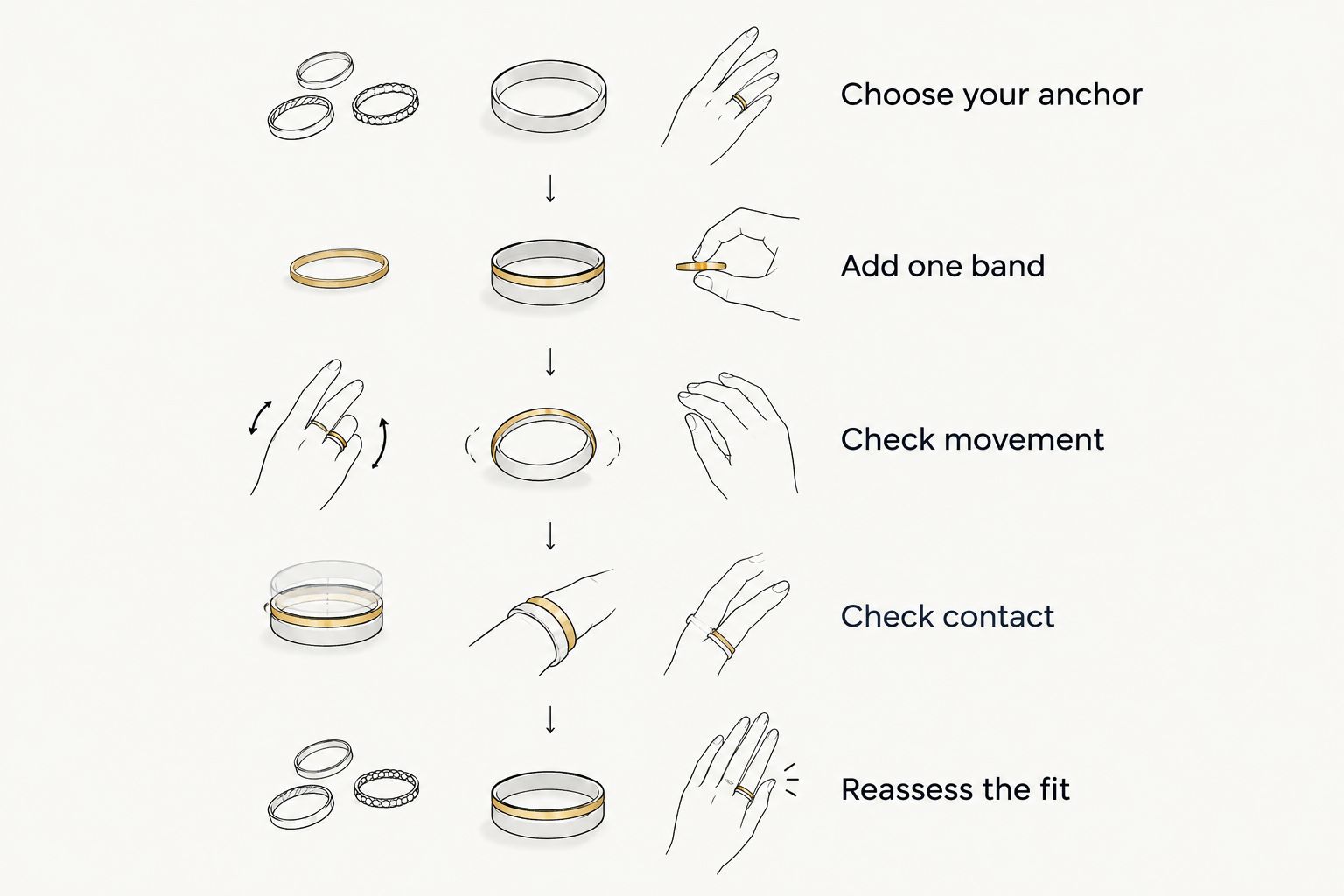
A useful stopping point is the first combination that feels settled and looks intentional. You do not need another ring simply because there is still a visible strip of skin. Space can be part of the arrangement.
How do you compare widths when shopping online?
Read the stated measurements for each ring and distinguish band width from the dimensions of a stone or decorative face. A ring can look broad from above because of its setting while having a narrower band beneath it.
If measurements are unclear, ask which part of the ring the measurement describes. Request guidance on the band, the setting and the overall profile rather than asking only whether the piece is suitable for stacking.
For an online shortlist in 2026, keep a note of the intended finger, the rings you already own and the combination you want to create. That gives a jeweller a specific fit question to answer. A photograph of your existing arrangement can help explain the shapes involved, but it does not replace a fit assessment.
Black Betty stacking rings should be assessed piece by piece, just as you would assess any meaningful addition to your jewellery. The brand's jewellery offering does not establish that every ring has the same materials, dimensions or stacking clearance.
Should stacking rings all be the same width?
Stacking rings do not need to be the same width. Similar widths emphasise repetition, while different widths establish a focal point. Choose the arrangement that supports the piece you want to notice first.
If you are unsure, change only one element at a time. Keep the anchor ring and swap its neighbour, rather than changing width, texture and placement together. That makes your preference easier to recognise.
Will adding another band change my ring size?
Adding another band changes the combined fit, but it does not establish an automatic size adjustment. Assess the complete stack on the intended finger and ask a jeweller whether the size or the arrangement needs changing.
Avoid treating discomfort as something to get used to. If the stack pinches or is difficult to remove, take it off and reassess the combination rather than continuing to add bands.
Can I mix gold and silver stacking rings?
You can choose gold and silver stacking rings for visual contrast, but colour does not tell you whether the pieces fit safely beside each other. Check the actual materials, finishes, settings and care requirements of each ring.
For a considered look, repeat a shape or texture while changing the metal colour. The benefit is contrast with a connecting detail; the limitation is that different pieces can require different care. Ask for advice on the specific combination rather than applying one cleaning method to the whole stack.
FAQ
What's the best band width for stacking rings?
The best band width is one that works within a comfortable combined stack on your intended finger. Check movement, coverage and setting clearance rather than choosing a universal measurement.
How many stacking rings should I start with?
Start with 2 rings as a practical styling exercise, then assess the complete fit before adding another. The number is a starting point, not a rule or a target.
Are thinner stacking rings always more comfortable?
Thinner stacking rings are not automatically more comfortable as a complete stack. Several slim bands still create combined coverage, and their edges and settings also affect the fit.
Should I size up for a wide ring stack?
Do not size up automatically for a wide ring stack. Ask a jeweller to assess the full combination, because changing size does not reduce the space the bands cover along your finger.
Do stacking rings need to sit flush together?
Stacking rings do not need to sit flush together. A gap is preferable to forcing a neighbouring band against a stone or setting.
How should I choose stacking rings online in 2026?
Choose stacking rings online in 2026 by checking the stated band measurements, materials and setting profile. Ask about any unclear dimensions before deciding how a new ring will sit beside pieces you own.
One last thing
Before choosing another band in 2026, try your existing rings in a different order. Moving a slim band from one side of a focal ring to the other changes the arrangement without adding more coverage.
Choose the stack you want to wear, not the fullest stack you can assemble. That leaves room for touch, movement and the particular piece you wanted to carry with you in the first place.