
Clean a birthstone necklace with the gentlest method suited to its gemstone, metal and setting: start with a soft, lint-free cloth, and use lukewarm water with mild soap only when the materials and treatments permit it. Do not soak an unidentified stone or put it in an ultrasonic cleaner. In 2026, the safest starting point remains the same: identify the piece before choosing the cleaner.
- Clean a birthstone necklace according to its gemstone, treatments, metal and setting—not its birth month alone.
- Start with a soft cloth; reserve soap and water for materials confirmed suitable for wet cleaning.
- Avoid toothpaste, boiling water and ultrasonic cleaning when gemstone treatments are unknown.
- Black Betty jewellery suits South African shoppers choosing personal gemstone pieces; care must match the individual necklace.
Why this matters
A necklace rests against skin, collects oils and meets products such as sunscreen and perfume. Removing that residue keeps the surface clear, but stronger cleaning is not automatically better. A method suitable for one gemstone can damage another, and a silver-cleaning product is not necessarily suitable for the stone beside it.
Black Betty’s natural gemstone necklace pairs a faceted gemstone with a fine chain. That combination needs attention to both parts, rather than treating the pendant as an isolated stone. For your 2026 care routine, keep the individual piece’s instructions ahead of general jewellery advice.
How do you clean a birthstone necklace without damaging it?
Identify the materials, inspect the setting, remove surface residue gently and dry the necklace before storing it. Stop if you find damage or cannot establish whether wet cleaning is suitable.
1. Identify the gemstone and metal
Check your order details or product description for the gemstone, chain metal and finish. Look for information about treatments, coatings, glued components or special care instructions. A birth month alone does not provide those details.
Natural does not mean untreated. If the description does not settle the question, ask the jeweller whether the entire necklace—not just the gemstone—can be cleaned with mild soap and water.
2. Inspect before adding water
Lay the necklace on a clean, soft surface in good light. Look for a bent claw, a visibly loose stone, a damaged clasp, a kinked chain or a new chip.
Do not test a setting by pushing the gemstone. A loose stone needs inspection, not a more thorough clean. Keep a damaged necklace out of your wearing rotation until a jeweller checks it.
3. Start with a gentle surface wipe
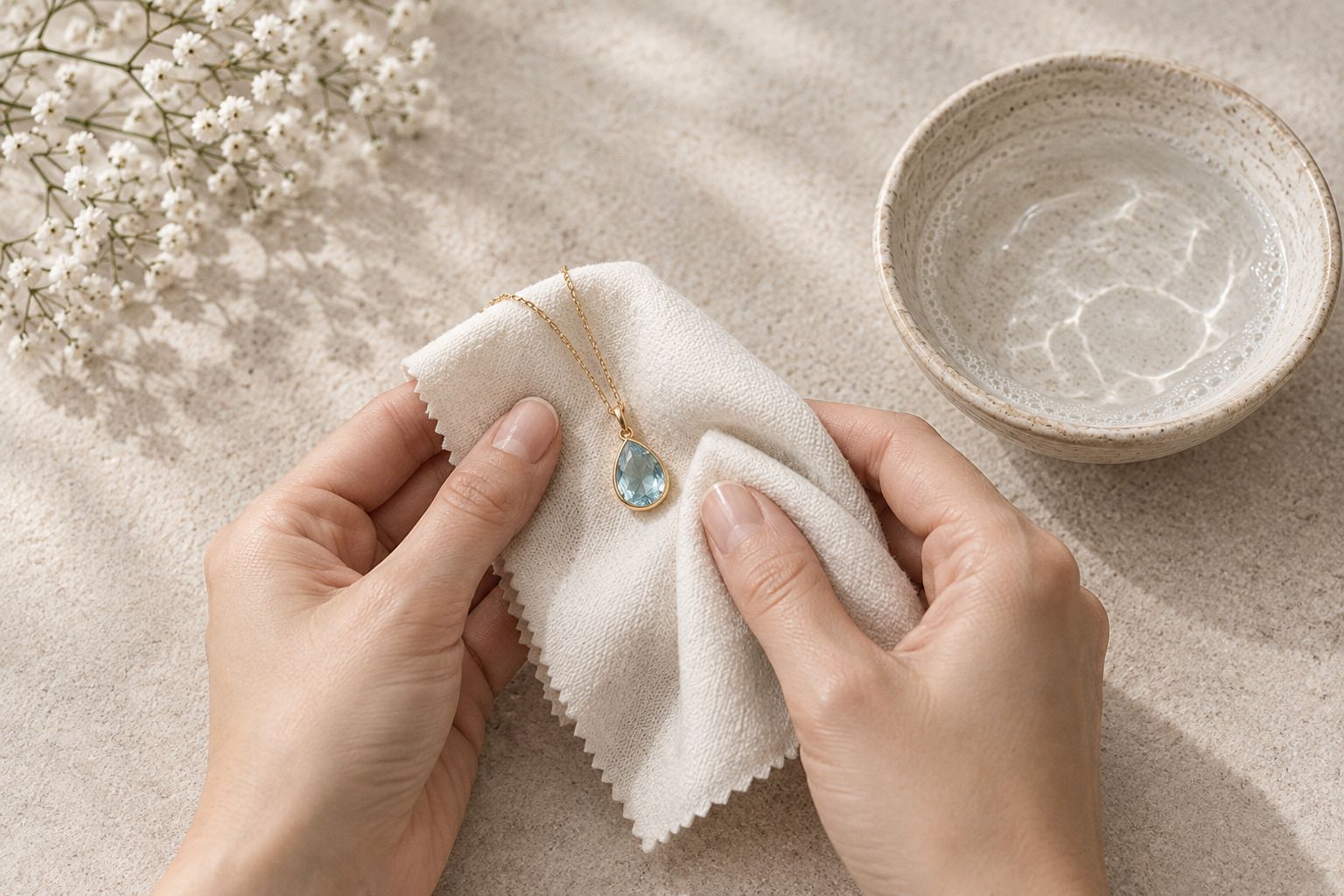
Use a clean, soft, lint-free cloth without polishing compounds. Support the pendant in your hand and wipe lightly, rather than pulling the chain through a tightly pinched cloth.
This is the least involved option for fingerprints and light surface residue. It will not remove every deposit, and it is not a substitute for professional attention when dirt sits beneath a delicate setting.
4. Use mild soap only when suitable
For a necklace confirmed suitable for wet cleaning, prepare lukewarm water with a little mild soap in a clean bowl. Avoid hot water, abrasive cleaners and household cleaning mixtures. Do not turn a gentle wash into an extended soak.
Use your fingertips or a soft cloth to loosen residue. A very soft brush belongs only on materials and settings approved for brushing; never force bristles under claws or scrub a plated surface.
5. Remove residue and dry carefully
For water-safe jewellery, remove soap with clean lukewarm water over a bowl, not an open plughole. Support the necklace throughout. Avoid sudden changes in water temperature.
Pat dry without rubbing hard, then leave the necklace on a clean cloth until it is dry before putting it away. Do not use a hairdryer or place it on a heater to hurry the process.
Which cleaning method should you choose?
Choose the least intensive method that addresses the residue. The table below compares cleaning approaches, not interchangeable treatments: suitability still depends on the complete necklace.
| Method | Best for | Advantage | Limitation |
|---|---|---|---|
| Plain soft cloth | Light fingerprints and surface oils | Gentle, controlled surface cleaning | Cannot reach trapped residue |
| Mild soap and lukewarm water | Necklaces confirmed suitable for wet cleaning | Removes everyday residue without abrasive paste | Unsuitable for some stones, treatments and constructions |
| Metal polishing cloth | Exposed metal specifically approved for polishing | Targets tarnish on suitable metal | Polishing compounds can affect finishes or neighbouring materials |
| Jeweller assessment | Unknown treatments, loose settings or stubborn deposits | Matches cleaning to the piece’s condition | Requires assessment rather than an immediate home clean |
Do not escalate from cloth to chemicals simply because a mark remains. What looks like dirt can be tarnish, a worn finish or damage. Those need different responses.
How should you clean delicate or treated gemstones?
Pearls, opals and emeralds need material-specific care. Their sensitivities differ, so a single instruction to soak all birthstone jewellery is poor advice.
For pearls, gently wipe after wear with a soft cloth, lightly dampened when appropriate, and avoid immersion that wets the stringing. For opal, establish the construction first: a solid stone, doublet and triplet do not have identical care requirements.
Emeralds are often fracture-filled, which makes treatment information particularly important. Avoid ultrasonic and steam cleaning, and ask for instructions before using chemicals or soaking the necklace. A clean surface is not worth disturbing a treatment.
If your necklace combines several gemstones, follow the care needs of the most sensitive component. The chain being suitable for water does not settle the question for the pendant.
Can hard gemstones still be damaged during cleaning?
Yes. Scratch resistance does not establish cleaning safety. Diamond measures 10 on the Mohs hardness scale, corundum—including sapphire and ruby—measures 9, and quartz measures 7, as recorded in GIA’s gemstone reference material.
Those figures describe resistance to scratching. They do not certify resistance to impact, sudden temperature changes, chemicals or a particular cleaning machine. A hard stone can still have fractures, treatments or a vulnerable setting.
For 2026 care decisions, use gemstone identification as the beginning of the check, not permission to scrub. Even a durable stone needs a secure mount and a cleaning method appropriate to its treatments.
Does the necklace’s metal change the cleaning method?
Yes. Solid gold, sterling silver and gold-plated silver do not need identical surface care. First establish what you own; a gold-coloured surface alone does not identify the construction.
Gold plating is a surface layer, so abrasive pastes and vigorous polishing are poor choices. Do not assume a silver polishing cloth is suitable just because the metal beneath the plating is silver. Follow the finish-specific instructions instead.
Sterling silver tarnish also differs from oily residue. If a plain cloth does not address it, check whether a tarnish-removal method is safe for the gemstone and setting before proceeding. Keep metal-specific cleaning products away from neighbouring materials unless their suitability is confirmed.
With a fine chain, handling matters as much as the solution. Support sections as you clean, avoid tugging through knots and stop if links catch or appear distorted.
Why birthstone necklace care varies in 2026
The right method depends on the necklace’s construction, not its symbolism. Check these factors before choosing a cleaning product:
- Gemstone identity: different minerals respond differently to moisture, heat and chemicals.
- Treatments: fracture filling, coatings and other treatments can change cleaning restrictions.
- Metal finish: plated surfaces need different handling from exposed solid metal.
- Setting condition: damaged claws and loose stones rule out routine home cleaning.
- Additional materials: pearls, stringing, adhesives and mixed components need their own checks.
- Type of residue: fingerprints, trapped dirt, tarnish and worn plating are not the same problem.
If you cannot answer one of those questions, keep cleaning limited and ask for guidance. Guessing at the stone from its colour is not enough.
Can I use toothpaste or bicarbonate of soda?
Skip toothpaste and abrasive bicarbonate pastes on a birthstone necklace. Abrasive particles can scratch softer materials and wear finishes, while paste can collect around settings.
A household ingredient is not automatically a jewellery-safe cleaner. Avoid combining ingredients into a stronger mixture, and do not use vinegar or bleach as a general-purpose gemstone treatment. Use a method confirmed for the piece instead.
Can I put my birthstone necklace in an ultrasonic cleaner?
Do not use an ultrasonic cleaner unless a jeweller confirms the complete necklace is suitable. These machines are inappropriate for various delicate, fractured or treated gemstones, and vibration can create problems around insecure settings.
A home machine cannot identify a treatment or assess a claw. Owning one does not remove the need for those checks; a jeweller can decide whether ultrasonic cleaning belongs in the care process at all.
When should I stop cleaning and ask a jeweller?
Stop when you notice movement, damage, persistent discolouration or uncertainty about the materials. A new snag, a bent claw or an unusual gap around the gemstone deserves inspection before further wear.
Do not prise out compacted residue with a needle or try to tighten a setting yourself. Black Betty offers jewellery cleaning and repairs; use the contact page to ask about care for your particular necklace before choosing a treatment.
Describe what changed and what you have already used on the piece. That information is more useful than asking for the strongest cleaner.
Build a simpler after-wear routine
Put your necklace on after applying perfume, lotions and sunscreen. Remove it before swimming, household cleaning and activities that expose it to chemicals or pulling. These habits reduce the residue you need to remove later.
After wear, give suitable surfaces a light wipe and store the dry necklace separately from other jewellery. Fasten the chain and lay it without tight bends; avoid dropping it into a loose pile where pendants and chains rub together.
Choose a routine you will actually keep. A careful surface wipe and sensible storage are better than neglect followed by an aggressive attempt to restore shine.
FAQ
What is the safest way to clean a birthstone necklace at home?
Start with a clean, soft, lint-free cloth and use wet cleaning only when the gemstone, treatments, metal and construction permit it. Stop if the setting is damaged or the materials are uncertain.
Can I clean my birthstone necklace with washing-up liquid?
Mild soap and lukewarm water suit some birthstone necklaces, but not every gemstone, treatment or construction. Confirm suitability for the complete piece before washing, and avoid abrasive or strongly formulated household cleaners.
How often should I clean a birthstone necklace in 2026?
Base cleaning on visible residue, wear and the necklace’s care instructions rather than a fixed calendar. A gentle after-wear wipe reduces build-up without repeatedly exposing the piece to cleaning solutions.
Can I soak a gemstone necklace overnight?
Do not soak an unidentified gemstone necklace overnight. Prolonged immersion is unsuitable for some treatments, glued components and stringing, so follow the piece-specific instructions instead.
Is a silver polishing cloth safe for a gold-plated necklace?
Do not assume a silver polishing cloth is safe for gold plating. Polishing compounds and rubbing can affect the surface finish; use the method recommended for the plated piece.
Why does my necklace still look dull after cleaning?
Persistent dullness needs assessment because residue, tarnish, worn plating and surface damage require different responses. Stop repeating the same treatment and ask a jeweller to identify the cause.
Can Black Betty help with cleaning my gemstone necklace?
Black Betty offers jewellery cleaning and repairs. Ask about the care needs and condition of your specific necklace rather than assuming every gemstone piece receives the same treatment.
One last thing
Before your next clean in 2026, save the necklace’s material details alongside your order confirmation. Include any treatment information and the care instructions you receive. You will have something more reliable than a guess based on colour when the pendant needs attention again.
Care follows construction, not meaning. Your birthstone can carry a personal story; the cleaning method still belongs to the actual stone, finish and setting.