
Best overall: a half-eternity ring for everyday wear. Best for an unbroken line of stones: a full-eternity ring. Best for personal symbolism: a birthstone ring, if you prefer an alternative to the traditional eternity band. This 2026 guide compares six styles for marking your own milestone, with practical guidance on fit, settings and building a stack you want to wear.
- A half-eternity ring is the default choice when everyday comfort and future sizing matter.
- Full-eternity rings carry stones around the entire band; confirm resizing options before choosing.
- Black Betty suits milestone-ring shoppers drawn to black diamonds, birthstones and individual stacking combinations.
- Birthstone rings and curved gemstone halos are meaningful alternatives, not traditional eternity bands.
Why this matters
An eternity ring does not need to mark a wedding anniversary. You can choose one for a new chapter, a hard-earned achievement or a promise you make to yourself. The meaning belongs to you; the setting still needs to suit your hand.
Black Betty offers jewellery and personalised experiences for South African shoppers, including bespoke design. Start with how you want the ring to feel, then decide how literally you want to follow the eternity-band tradition.
What makes the best eternity ring?
For a ring you plan to live with in 2026, these criteria matter more than the occasion printed on its box:
- Stone coverage: Full and half eternity describe how far the stones continue around the band.
- Setting profile: Look at the ring from the side. Height and exposed edges affect how it sits beside another ring.
- Finger comfort: Check the underside and the spaces between your fingers, not just the view from above.
- Future fit: Ask what resizing the exact design allows before committing to a size.
- Material clarity: Confirm the metal, gemstones and any treatments for the particular piece.
- Personal meaning: Choose a colour, form or stone you enjoy without needing an occasion to explain it.
Eternity ring styles at a glance
These styles are not mutually exclusive: a half-eternity ring can also have channel-set black diamonds. The ranking separates the main reason you would choose each one. The final two entries are deliberately labelled alternatives.
| Style | Best for | Standout feature | Key limitation |
|---|---|---|---|
| Half-eternity ring | Everyday milestone wear | Stones across the visible upper section | Plain metal shows when the ring rotates |
| Full-eternity ring | Continuous stone coverage | Stones around the entire circumference | Resizing is more restrictive |
| Channel-set eternity ring | A preference for contained stone edges | Stones held between parallel metal walls | A more metal-framed appearance |
| Black-diamond eternity ring | Contrast within a personal stack | Dark stones rather than a clear-diamond look | Not the choice for a bright, transparent effect |
| Curved gemstone halo ring | Framing an existing solitaire | A shaped line that follows another ring | Fit depends on the neighbouring setting |
| Birthstone solitaire ring | Marking a personally significant month | One focal gemstone | Not a traditional eternity band |
For the fourth style, the Ultra Light Eternity Band in Black Diamond is a Black Betty starting point. Confirm its metal, stone coverage, dimensions and sizing options before deciding; the name alone does not establish those details.
1. Half-eternity ring: best for everyday milestone wear
A half-eternity ring places a row of stones across the upper part of the band, leaving a plain section underneath. It gives you the repeated-stone appearance without continuing that setting around the whole finger.
Best for: Your first milestone band, especially when you want to wear it beside rings you already own. For an undecided shopper, this is the strongest starting point—not a guarantee that every half-eternity design will feel comfortable.
Half-eternity ring pros:
- A plain underside avoids stones beneath the finger.
- The visible row creates a clear, repeated pattern.
- Some designs offer more resizing scope than full-eternity bands.
Half-eternity ring cons:
- Rotation exposes the plain section.
- Resizing still depends on the setting and construction.
Try the ring on its own before adding another band. If the stone section repeatedly slips away from the top of your finger, address the fit rather than accepting constant adjustment.
Verdict: Buy a half-eternity ring as the default, subject to fit.
2. Full-eternity ring: best for continuous stone coverage
A full-eternity ring carries stones around the entire band. The repeated pattern remains visible as the ring turns, making continuity part of both its appearance and its symbolism.
Best for: You want the complete circle to be the defining feature, rather than simply a row of stones across the top. Choose this construction intentionally, not because “full” sounds like an upgrade.
Full-eternity ring pros:
- The stone pattern continues around the finger.
- Rotation does not reveal a deliberately plain underside.
- The complete circle offers a direct symbol of continuity.
Full-eternity ring cons:
- Resizing is more restrictive and sometimes impractical.
- Stones and settings sit beneath and between your fingers.
- The entire circumference needs inspection and care.
Try gripping a bag handle and closing your hand gently. A ring that looks right but presses uncomfortably between your fingers is not the right fit for daily wear.
Verdict: Buy for the complete-circle design; skip if resizing flexibility is essential.
3. Channel-set eternity ring: best for contained stone edges
A channel setting holds a row of stones between parallel walls of metal. It describes the setting, not the extent of stone coverage, so you still need to choose between a full or partial row.
Best for: You prefer a structured band with a clear metal outline. The visual effect is more contained than a design where individual claws define each stone.
Channel-set eternity ring pros:
- Metal walls frame the stones in a continuous line.
- The design avoids individual projecting claws along that row.
- It offers a clear contrast to a delicate claw-set solitaire.
Channel-set eternity ring cons:
- More visible metal changes the balance between stones and band.
- Dirt can collect beneath and around the stones.
- Channel construction does not make the ring impact-proof.
Inspect the inner surface as well as the top. Ask how the ring should be cleaned and how the setting is checked; a contained appearance is not permission to neglect maintenance.
Verdict: Buy for a defined metal frame, not a promise of indestructibility.
4. Black-diamond eternity ring: best for contrast in a ring stack
A black-diamond eternity ring replaces the clear-stone look with a dark line. The effect centres on contrast and surface rather than the transparent appearance associated with colourless diamonds.
Best for: You want a milestone ring with a quieter, darker expression. Black Betty’s eternity-ring option belongs on your shortlist when black diamonds—not a particular unverified metal or setting—are the attraction.
Black-diamond eternity ring pros:
- Dark stones establish a distinct visual line.
- The colour creates contrast beside lighter gemstones.
- It offers an alternative to conventional clear-diamond styling.
Black-diamond eternity ring cons:
- It does not deliver the same transparent look as colourless diamonds.
- Colour alone tells you nothing about setting comfort.
- Stone treatment and care requirements need confirmation.
For your 2026 shortlist, compare the ring against the pieces you actually wear. A dark band can become the anchor of a stack, but you should like it alone too.
Verdict: Buy for deliberate contrast; skip if transparent sparkle is your priority.
5. Curved gemstone halo ring: best for framing a solitaire
A curved gemstone halo follows the outline of another ring rather than forming a straight row across your finger. It is a shaped stacking alternative, not automatically an eternity ring.
Best for: You already own a solitaire and want the milestone piece to change its silhouette. The Ruby Halo Ring in 9kt Yellow Gold is described as designed to sit above a solitaire, making it relevant to this approach.
Curved gemstone halo ring pros:
- A shaped outline can frame an existing focal stone.
- Coloured gemstones introduce a separate personal choice.
- The stack becomes a composition rather than repeated straight bands.
Curved gemstone halo ring cons:
- A curve does not guarantee compatibility with your solitaire.
- Contact between settings needs checking.
- The shape gives a different effect when worn alone.
Try both orientations around your existing ring. Look from the side for contact with claws and the stone, then move your hand naturally to see whether the arrangement holds its position.
Verdict: Buy only after checking the pair together.
6. Birthstone solitaire ring: best for a significant month
A birthstone solitaire puts one gemstone at the centre of the story. It is not an eternity band, but it can mark the same milestone without borrowing the traditional repeated-stone format.
Best for: Your chosen month matters more than the symbolism of an unbroken circle. The Birthstone Ring in 9kt Rose Gold has a natural faceted gemstone in a four-claw setting, with a 4.5mm gemstone and a 2mm band.
Birthstone solitaire ring pros:
- One stone gives the ring a clear focal point.
- A month or colour can hold personal significance.
- The rose-gold option offers verified dimensions for comparison.
Birthstone solitaire ring cons:
- It does not provide a continuous row of stones.
- Gemstone-specific care matters.
- The setting still needs checking against adjacent bands.
Treat birthstone associations as symbolism or personal interpretation, not promises about health or energy. You can also choose a colour simply because you love wearing it.
Verdict: Buy for personal symbolism, not as a substitute for verified eternity-band construction.
The following Black Betty pieces support the two alternative approaches above. Choose the birthstone ring for a single focal gemstone or the ruby halo for a shaped addition to an existing solitaire.


Full or half eternity: decide from the underside
The practical difference between full or half eternity bands is not just the view from above: stone coverage changes what sits beneath your finger and what resizing work the construction permits. Both deserve a proper fitting.
Choose full coverage when the continuous setting is essential to the design you want. Choose partial coverage when you prefer a plain underside, while confirming the exact ring’s resizing limits. Neither label establishes quality by itself.
Before choosing an eternity ring in 2026, ask the jeweller to explain what happens if your size changes. A clear answer about the particular construction is more useful than a general reassurance that rings can be resized.
Check the whole stack, not just the new ring
Put your existing rings on first, then add the milestone band. Look at the complete arrangement from above and from the side; two attractive rings do not automatically make a comfortable pair.
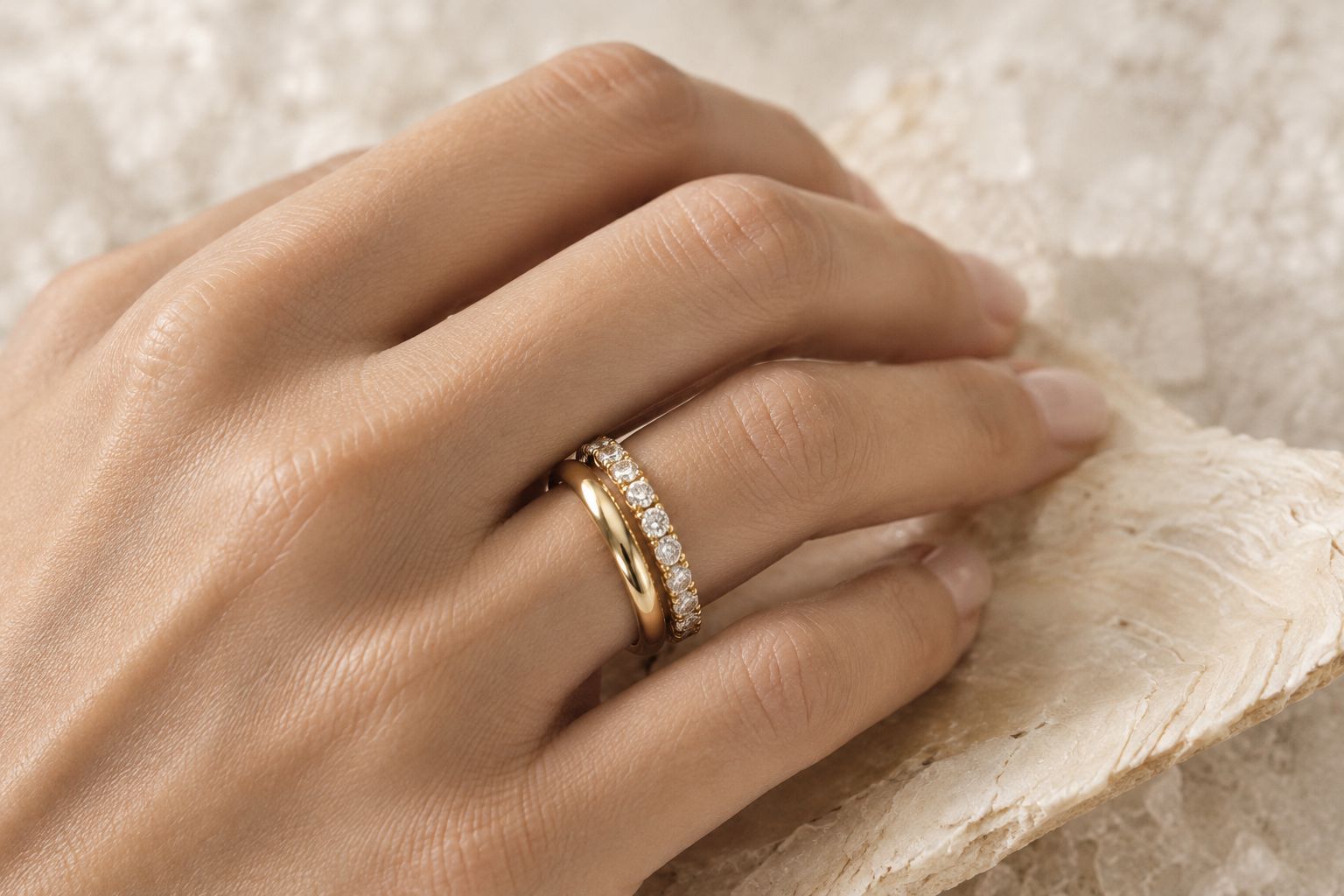
Use this fitting sequence:
- Close your hand: Notice pinching and pressure between fingers.
- Check contact: Look for a stone or claw rubbing against its neighbour.
- Change the order: Move the new ring above and below the existing band.
- Wear it alone: Make sure the milestone piece still feels complete by itself.
A visible gap is not automatically a problem. Forcing bands together is the poorer choice when their settings do not accommodate it. Ask a jeweller whether a different profile or a spacer suits the particular pairing.
Care starts with the actual materials
Build your 2026 care routine around the ring’s metal, stones and treatments. Do not assume that a cleaning method suitable for a diamond band also suits every coloured gemstone.
Remove rings before activities involving impact, abrasive materials or strong chemicals. Store pieces separately to limit rubbing, and arrange an inspection if a stone moves, a claw catches or the band changes shape.
For a mixed-gemstone stack, request care instructions for each ring. Avoid ultrasonic or steam cleaning unless a jeweller confirms suitability for the complete piece, including its stones and any treatments.
How the styles were ranked
The ranking prioritises everyday fit, setting comfort, future sizing and personal meaning. Half eternity takes the default position because it combines a visible stone row with a plain underside; the remaining styles answer distinct preferences rather than represent descending quality.
These are design-based recommendations, not wear-test results. The named product details are limited to the supplied catalogue information, and the two milestone alternatives are not presented as traditional eternity bands.
Which eternity ring should you choose?
Choose a half-eternity ring if you want a clear starting point for everyday wear. Move to full eternity only when continuous stone coverage matters enough to accept its sizing and comfort considerations.
For a more individual 2026 choice, decide whether your priority is black-diamond contrast, a curved addition to a solitaire or a personally significant birthstone. The right milestone ring needs no borrowed story. It needs to fit your hand and mean something to you.
FAQ
What's the best eternity ring style for everyday wear?
A half-eternity ring is the best starting point for everyday wear because it combines a visible stone row with a plain underside. Confirm the particular ring’s fit, setting profile and resizing options before choosing.
Can I buy an eternity ring for myself?
Yes, you can choose an eternity ring to mark your own milestone. A personal achievement, new chapter or private commitment needs no anniversary attached to it.
Is a full-eternity ring better than a half-eternity ring?
A full-eternity ring is better for continuous stone coverage, not automatically better overall. A half-eternity ring offers a plain underside, while full-eternity construction brings more restrictive resizing considerations.
Can an eternity ring be resized?
Resizing depends on the exact eternity ring’s construction. Full-eternity settings are more restrictive, so ask a jeweller about the specific design before committing to a size.
Can I wear an eternity ring beside a low-set solitaire?
You can wear an eternity ring beside a low-set solitaire only when the profiles work together without harmful contact. Try the pair together and have a jeweller check the settings rather than forcing the bands flush.
Is a birthstone ring an eternity ring?
A single-stone birthstone ring is not a traditional eternity ring. It is a milestone alternative for someone who prefers one personally significant gemstone to a repeated row.
What should I check before choosing a black-diamond eternity ring?
Check the metal, stone coverage, dimensions, diamond treatments and resizing options for the particular ring. Black diamonds establish a colour choice, not a guarantee about comfort or construction.
One last thing
Before choosing your milestone ring, remove every other ring and try it alone. If the piece only works inside a carefully arranged stack, decide whether that dependence suits you. A ring chosen for your own milestone deserves to feel right on its own terms.