
Yes, you can wear stacking rings around a low-set engagement ring if the bands clear the setting without pressing against its claws, gemstone or underside. A curved band, an open band or a straight band with a deliberate gap can work; when choosing your stack in 2026, prioritise safe clearance and comfortable movement over a perfectly flush appearance.
- Stacking rings can sit beside a low-set engagement ring without fitting flush against it.
- Curved bands follow the setting; open bands leave space; straight bands can retain a deliberate gap.
- Check the stack from the side: avoid contact with gemstones, claws and the underside of the setting.
- Black Betty offers jewellery, bespoke design and repairs for shoppers considering a personal ring stack.
Can you stack rings around a low-set engagement ring?
Yes. The deciding factor is clearance beside the setting, not whether the bands touch all the way around. A low-set centre stone can leave little room for a neighbouring band to pass beneath it. Instead of forcing a straight band underneath, choose a shape that leaves the setting undisturbed.
Band width also changes how the stack sits on your finger. Use the guide to choosing band widths for stacking rings alongside a side-on fit check, rather than judging the combination only from above.
| Band approach | Best for | Advantage | Limitation |
|---|---|---|---|
| Curved or contoured band | Following the outline of a projecting setting | Leaves shaped space around the centre setting | The curve must match the actual ring, not just the stone shape |
| Open band | Leaving space directly beside the centre setting | Its opening can accommodate an obstruction | The ends need checking for pressure and unwanted contact |
| Straight band with a gap | Keeping a simple, independent band shape | Does not require a close contour match | A visible gap remains between the rings |
| Bespoke fitted band | A setting that standard shapes do not accommodate | Allows the band to be designed around the engagement ring | Requires individual design and fitting decisions |
Why this matters
A ring stack is something you feel as well as see. A combination that photographs neatly can still pinch, rotate or press against a setting when you close your hand.
For a stack you plan to wear throughout 2026, begin with your existing engagement ring rather than a reference photograph. Its underside, shoulders and stone position determine what fits beside it. A small gap is a design choice; pressure against a setting is a fit problem.
Curved bands: best for following the setting
A curved or contoured band creates a recess around the engagement ring's centre setting. The shape can bring the bands visually closer without requiring the stacking band to slide underneath the stone.
Check where the curve begins and ends. A band that follows the gemstone's outline from above can still meet a claw or the metal supporting the stone underneath.
- Choose it for: a stack that follows the engagement ring's outline.
- Check carefully: the depth of the curve and clearance at its shoulders.
- Accept the trade-off: the band will have a shaped profile when worn alone.
Do not assume that a band described as curved fits every low-set engagement ring. The actual pairing needs inspection, especially where the setting projects beyond the engagement ring's shank.
Open bands: best for leaving space beside the centre setting
An open band leaves a break in the ring's upper outline. Positioned appropriately, that opening can leave room for a low setting rather than trying to pass beneath it.
The opening is not permission for the band ends to grip the engagement ring. Both ends should remain clear of vulnerable details as your hand moves and the rings shift.
- Choose it for: an intentional break around the centre setting.
- Check carefully: whether either end touches a claw, gemstone or neighbouring finger.
- Accept the trade-off: rotation can change where the opening sits.
Do not bend an open band at home to make it fit. Ask a jeweller whether its construction allows adjustment and whether the proposed position is suitable.
Straight bands: best for a deliberate gap
A straight band does not have to sit flush to belong in your stack. If the engagement ring's setting blocks its path, a visible space can preserve a simple band shape without crowding the centre stone.
This approach also lets you judge the band as a piece in its own right. You do not need to make every ring follow the engagement ring's outline.
- Choose it for: a clean band shape and a visibly separated stack.
- Check carefully: what happens when the rings slide towards each other.
- Accept the trade-off: the gap can change as the rings move.
Do not size down simply to hold a gap in place. Each ring must fit your finger comfortably, and the complete stack needs checking together.
Bespoke fitted bands: best for an unusual setting
A bespoke band is an option when standard contours do not accommodate the engagement ring. The design can account for the actual setting, rather than relying on a general description such as low-set, oval or solitaire.
Bring the engagement ring into the design discussion. Photographs help explain your preferences, but the jeweller needs to understand the ring's construction and the space around its setting.
- Choose it for: a particular outline or an engagement ring that resists standard pairings.
- Check carefully: clearance, comfort and how the band looks independently.
- Accept the trade-off: a closely fitted shape is tied to that engagement ring's geometry.
Ask whether the proposed band remains comfortable if it turns. A fitted appearance should not depend on holding your hand still.
How do you check whether stacking rings fit safely?
Use this sequence when trying on bands in 2026. Start with the engagement ring alone, then add a candidate band; adding an entire stack immediately makes it harder to identify the source of pressure.
- Side profile. Look across the finger at the setting's underside. Check whether the neighbouring band has room beside it rather than being pushed underneath it.
- Contact points. Inspect the claws, exposed gemstone edges, band ends and any raised details. Ask a jeweller to assess contact you cannot see clearly.
- Hand movement. Gently open and close your hand. Notice pinching, restricted bending or a band levering against the setting.
- Rotation. Check the pairing when the stacking band turns from its intended position. An opening or curve needs assessment beyond its neatest arrangement.
- Removal. Take the rings off without forcing them. Recheck the fit of the complete stack rather than assuming individually comfortable rings will feel identical together.
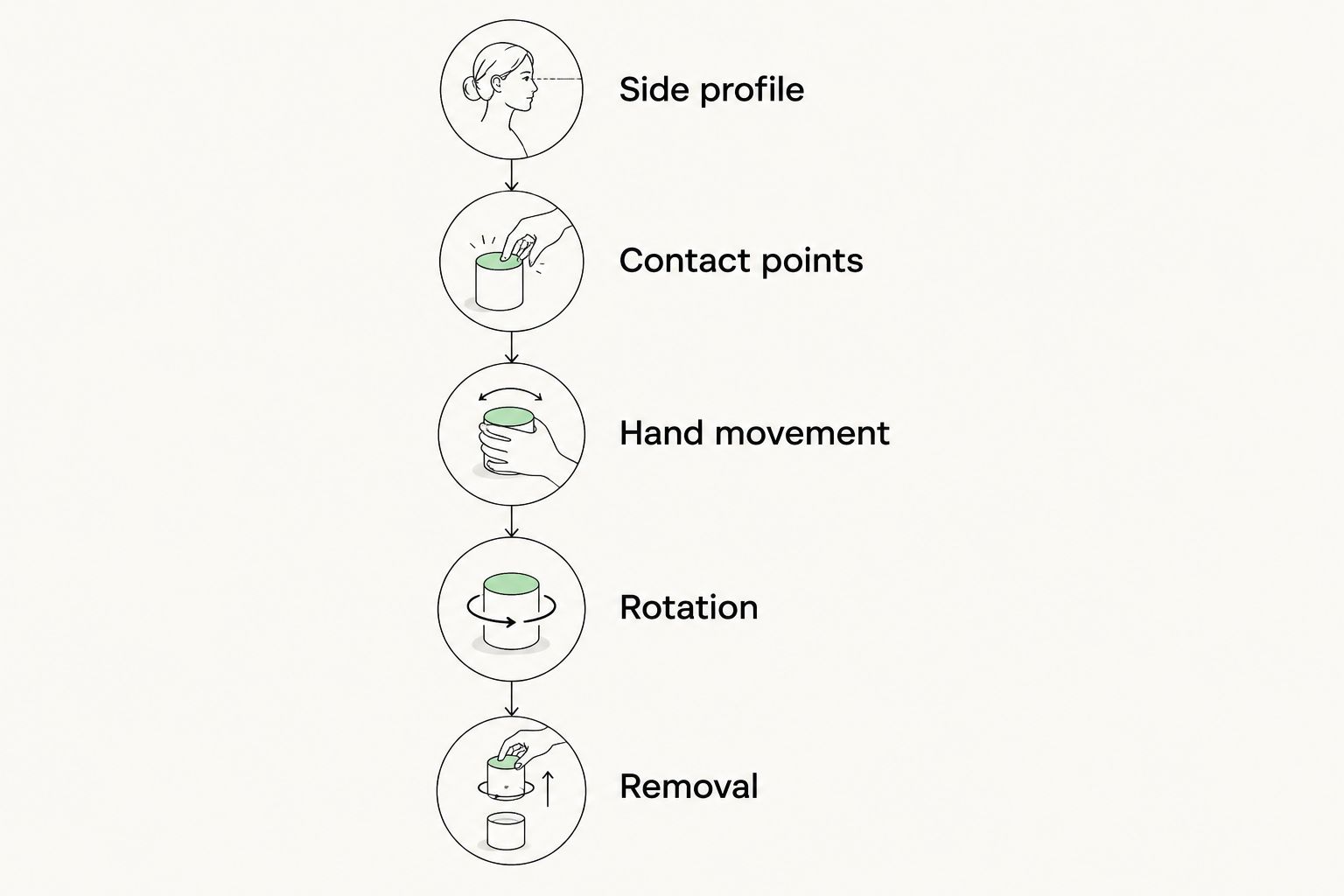
A snug-looking photograph is not a fit test. If you need to push the band into position, or the ring feels different once your hand moves, stop and have the pairing assessed.
Why stacking rings fit differently around low settings
The label low-set describes the centre setting's position, but it does not describe every surface that a neighbouring band encounters. These details determine which approach makes sense:
- Setting projection: metal or stone extending beyond the engagement ring's shank changes the available space.
- Underside construction: the supporting structure can obstruct a band even when the top view looks clear.
- Band width: additional width changes the total area covered on your finger.
- Band thickness: a taller band reaches a different part of the neighbouring setting.
- Surface details: claws, raised stones and open-band ends introduce contact points that a plain band does not have.
- Movement on the finger: turning and sliding change how the rings meet during wear.
There is no universal band measurement that resolves all these factors. Ask for dimensions when comparing pieces, then assess those dimensions against your own ring.
Can you put stacking rings on both sides of an engagement ring?
Yes, if each side has suitable clearance and the complete stack remains comfortable. The space above the centre setting is not necessarily the same as the space below it, so assess each pairing separately.
Begin with a band on one side. Once that pairing works, try the other side and repeat the movement checks with everything together.
A visually balanced arrangement does not require matching bands. You can use different outlines, or keep a gap on one side, provided the rings do not create unwanted contact or pressure.
Does a spacer band solve the problem?
A spacer band only helps if the spacer itself fits safely beside the engagement ring. It adds another ring between neighbouring pieces; it does not remove the obstruction created by a low setting.
Check its height as well as its width. A narrow spacer can still contact the underside of a setting, and the additional band increases the overall width of your stack.
Do not treat a spacer as protection by default. Ask a jeweller to identify what it separates, where it touches and whether that contact is appropriate.
Can you mix metals and gemstones in the same stack?
You can choose a mixed-metal or gemstone stack, but colour matching does not establish compatibility. Assess the construction, contact points and care requirements of each piece before combining them.
For a stack assembled in 2026, keep the material information for every ring. Use the stated metal and gemstone details rather than inferring composition from colour or appearance.
Pay particular attention to exposed stones and raised settings. Diamond can scratch other gemstones and metal, so avoid arrangements that place a diamond against a neighbouring ring's vulnerable surface.
Keep cleaning decisions separate from styling decisions. A method suitable for a plain metal band is not automatically suitable for every gemstone, treatment or setting in the stack; ask for care guidance for the actual combination.
Choosing a personal stacking ring
Black Betty is best for shoppers seeking jewellery alongside bespoke design and repair services. That makes a discussion about your existing ring more useful than choosing a companion from its front view alone.
The Mini Stone Stacker Ring is a relevant piece to consider, but its name does not establish whether it clears your engagement ring. Confirm its current material details, dimensions and fit beside your setting before deciding.
The benefit is the opportunity to choose a separate piece with its own place in your jewellery collection. The limitation is equally clear: no stacking ring is a universal fit for a low-set engagement ring. Bring the ring you already wear into the decision.
Discuss your ring stack
Ask Black Betty about fitting a companion band or exploring bespoke jewellery design.
FAQ
Can I wear stacking rings with a low-set engagement ring every day?
You can wear stacking rings with a low-set engagement ring when the pairing has suitable clearance and fits comfortably. Have a jeweller assess contact points, and follow the care guidance for each piece.
Does my wedding band have to sit flush with my engagement ring?
Your wedding band does not have to sit flush with your engagement ring. A deliberate gap is a valid choice when the centre setting prevents a straight band from sitting closely beside it.
Is a curved band better than a straight band for a low setting?
A curved band is better suited to following a projecting setting, while a straight band works with a deliberate gap. Neither shape guarantees a safe fit without checking the actual rings together.
Will a thin stacking ring fit underneath my engagement ring?
A thin stacking ring does not automatically fit underneath an engagement ring. Its thickness and the setting's underside matter alongside its width.
Should I size up when I add stacking rings?
Do not size up automatically when adding stacking rings. Have the complete stack fitted together because the combined width can change how it feels on your finger.
Can stacking rings damage engagement ring claws?
Repeated contact between a neighbouring band and engagement ring claws can cause wear. Ask a jeweller to inspect the pairing rather than relying on how neatly the rings sit in a photograph.
Can I bend an open stacking ring to fit around my stone?
Do not bend an open stacking ring yourself to fit around a stone. Ask a jeweller whether its material, setting and construction allow adjustment.
One last thing
Before settling on your 2026 stack, turn the companion band away from its ideal position. If the pairing only works when the rings stay perfectly aligned, it needs another fit check. Choose the combination that feels right in motion, not just the one that looks right at rest.